

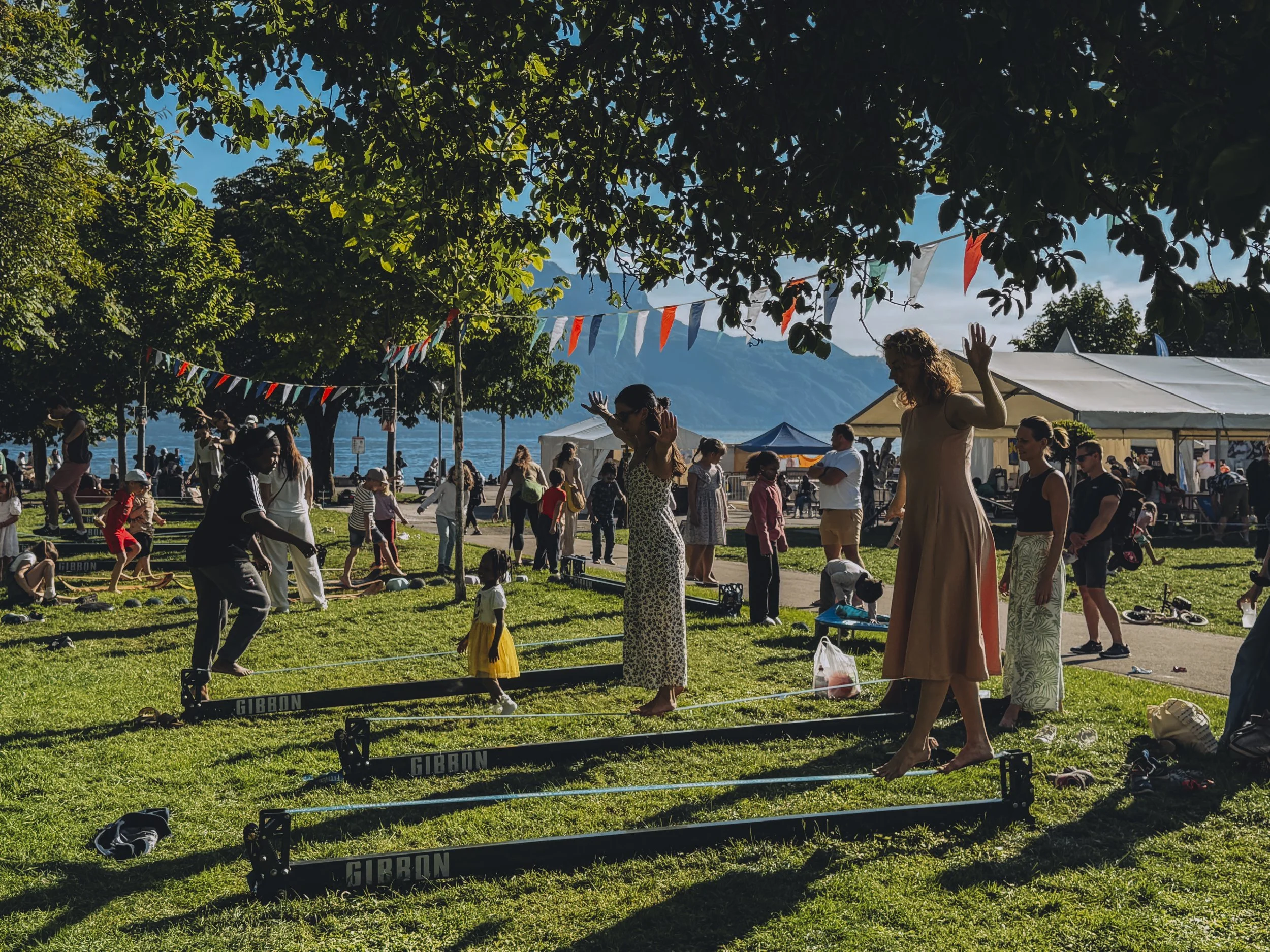
For three days, from May 16 to 18, 2025, the slackline activity took up residence at the Jardin du Rivage for the 43rd edition of the Animai Festival, organized by the City of Vevey. More than 2,500 people—from toddlers on the balance course to seniors curious to test their center of gravity—took part in the workshop. At the end of the weekend, the City of Vevey approved the activity for the next three editions of the festival.
This case study explains how we adapt a slackline activity for a family festival and why this format works particularly well at free, high-traffic events.
The City of Vevey's Objectives
The Animai Festival is a free event organized by the City of Vevey’s Youth Activities Office, with a clear mission: to offer families, children, and young people a space for discovery and hands-on experiences over the course of an entire weekend. According to figures released by the City, the event attracts between 3,000 and 5,000 people each year.
Three priorities for the sponsor:
An activity suitable for all age groups, without exception.
An activity that smoothly handles the festival's foot traffic, without any bottlenecks.
Professional guidance ensures the safety and quality of the experience.
Our proposal: a three-zone slackline setup, designed to operate simultaneously throughout the entire park.
Background & Challenges of a 100% Free Festival
At a free festival like Animai, two key considerations shape the entire lineup of activities. The first is efficiency. When a climbing wall or a trampoline results in a 30- to 45-minute wait, the experience quickly becomes frustrating—for both children and parents. The second is the diversity of the audience. A grandparent accompanying their four-year-old granddaughter should also be able to find something to try.
Le Jardin du Rivage offers an ideal layout: a flat lawn, trees spaced far enough apart for anchors, and a clear view from the main paths. This makes it possible to set up several slacklines side by side rather than a single, continuous line.
Our solution: three parallel slackline areas
We set up three complementary areas, supervised by a Slackline Events instructor, around the workshop.
1. Long slacklines — for teens and adults. These are long lines set at a height of 40–50 cm, which allow you to make real progress and sustain your effort.
2. Short slacklines —5 to 10 cm off the ground, suitable for both young children and seniors. This is the setup that always surprises people the most: grandparents discovering the thrill of balancing without any risk of falling.
3. The balance course — for children under six. Balance games and obstacles designed for toddlers who aren't yet able to stand on a balance beam.
The entire setup is installed between trees and certified anchor points and is inspected before each half-day of operation. For technical details, see also our recap of the acrobatic show at Forum Fribourg —the same meticulous installation process, but a different format.
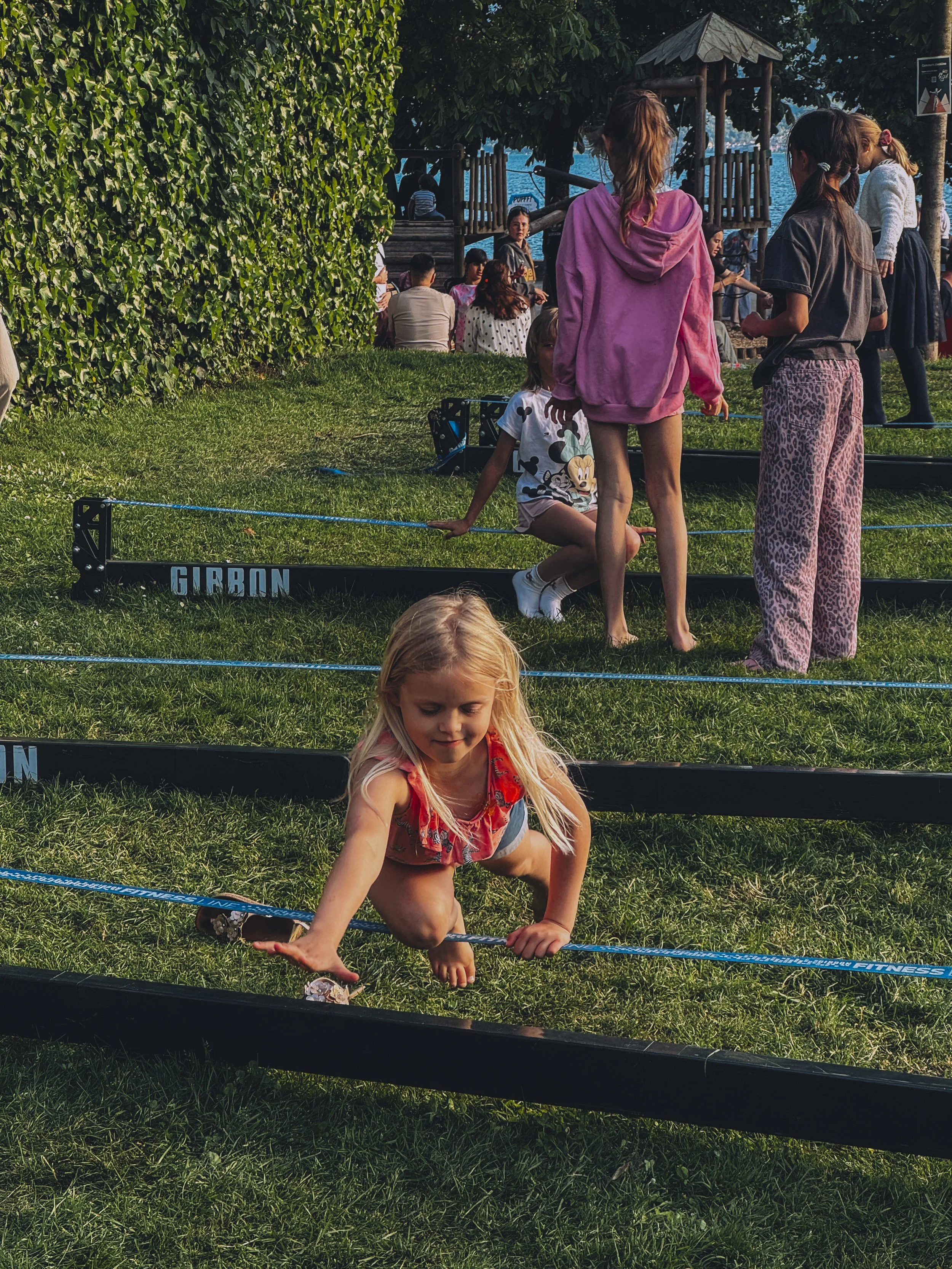
The Slackline Events Signature Slackline Events A card game to make the workshop more engaging
This is the element that turns a simple introduction into an experience. We have developed a proprietary deck of cards, which the instructor distributes throughout the session. Each card presents a challenge to be completed on the slackline: balancing on one foot, performing a spin, taking two steps backward, or crossing the line without looking at it.
The process is simple. A participant takes a card, tries it out on the slackline with the instructor’s guidance, and then comes back for another one. The cards structure the learning process, provide a clear goal, and create a cycle of engagement that’s much stronger than just a single crossing. The kids keep coming back all day long. Some adults stay for two to four hours. And—an important detail—they really make progress, because each card targets a specific skill.
Highlights of the weekend
Three things stood out from the weekend in Vevey.
First, the steady flow. At no point during the day did we have any lines. The facility’s capacity allows it to accommodate up to 100 people simultaneously across all areas without compromising the quality of supervision.
Next, the intergenerational aspect. Entire families—three generations—trying out the same activity, each at their own level. This is rare in the world of festival programming, and it’s exactly what the Youth Activities Office was looking for.
Finally, the sense of community. After an hour, a real energy takes hold: participants offer each other advice, cheer on successful attempts, and head back to pick up a new card. We see the same phenomenon at our corporate slackline events in Geneva, even though the audience is very different.
Results & spin-offs
During the three days of the 2025 Animai Festival:
Over 2,500 visits to the slackline workshop.
5-star Google reviews left by participants on the Slackline Events page.
The City of Vevey has signed an agreement to renew the event for the next three editions (2026, 2027, 2028).
This multi-year commitment reflects a trend we are seeing become more widespread among public sponsors: a contract covering multiple editions simplifies logistics for the City (a single application, a single budget plan), and in turn allows us to optimize our costs and offer a more competitive rate for each edition. It’s a win-win arrangement that we recommend to tourism offices and youth services that organize recurring festivals.
Tips for organizers of family festivals
Here are a few simple principles based on our experience with public events:
Prioritize continuous-flow activities over those with wait times. A workshop that can accommodate 100 people at once generates greater satisfaction than a ride that handles 20 people per hour.
Think intergenerationally from the very start of program design. Activities that exclude seniors or young children divide the family—and thus reduce the amount of time spent there.
Verify the qualifications of the staff. When working with the general public, safety depends on a trained instructor, not just a facilitator who was briefed that very morning.
Opt for multi-year contracts when the event is recurring. You’ll achieve greater brand consistency, streamline your internal bidding processes, and secure better rates.
Plan the required space in advance for events that require natural anchors (such as trees) or fixed points. Conducting a technical site survey beforehand helps avoid unexpected problems on the day of the event.
Let's talk about your next festival
Whether you’re a tourism office, a municipal youth department, or an agency organizing a family festival, we can tailor this format to your event. To learn more, check out our introductory slackline workshops and highline performances, or contact us directly at info@slackline-events.com to discuss a customized solution.
3. SEO FAQ
What activities should you choose for a free family festival in Vevey?
A slackline activity open to all ages is one of the best options for a free family festival. The setup takes just a few hours, accommodates all age groups at the same time, and doesn’t create long lines. Please see our slackline introductory workshops for details on how to set it up.
At what age can you start trying slacklining?
Children as young as three can try slacklining on very low lines (5 to 10 cm off the ground). For children under six, we offer a dedicated balance course with obstacles suited to their motor skills. Beyond that, there is no upper age limit: seniors regularly come to test their balance at our events.
How many people can participate in a slackline workshop at the same time?
A full-scale slackline course can accommodate up to 100 people at a time across all areas. Unlike a climbing wall or an activity that requires a harness, there are no lines or wait times, as participants can join or leave the activity at their own pace.
Is slacklining dangerous for children?
No, slacklining at a height of 5 to 30 centimeters above the ground poses a very low risk of injury. The activity is led by a professional instructor who supervises each crossing and adjusts the difficulty level to the participant’s age. This format is completely different from highlining at greater heights, which requires a different safety setup.
What is the budget for a slackline activity at a festival?
The budget depends on the duration (half-day, full day, weekend), the number of activity areas set up, and the number of instructors. A multi-year commitment covering two to three events helps reduce the per-unit cost, both in terms of logistics and fixed expenses. For a detailed quote, please contact us via the "Introduction" page.
How long does it take to set up a slackline workshop at an event venue?
Setting up a slackline course open to the public typically takes between two and four hours, depending on the number of zones and the type of anchor points available. At a site like the Jardin du Rivage in Vevey, we use existing trees after technical approval, which simplifies the setup process.
Can you set up a slackline without trees?
Yes, when the venue doesn't have suitable trees, we install freestanding structures or temporary anchor points. This is exactly what we did for the FC Bulle brunch and for indoor openings.
What happens in case of bad weather?
Slacklining can be done without any issues in light rain, but we avoid thunderstorms and strong winds for safety reasons. At a festival like Animai, we always plan ahead for an alternative location or a partial postponement, in coordination with the sponsor.
What is the difference between a slackline, a highline, and a trickline?
Traditional slacklining is practiced at a height of 30 cm to 1 meter above the ground and focuses on balance and walking. Highlining is practiced at heights of 10 to 100 meters (sometimes higher) between two elevated points, using a safety harness. Tricklining involves a dynamic slackline that allows for acrobatic tricks and jumps.
Do you offer slackline activities outside of Vevey and the Riviera?
Yes, we operate throughout French-speaking Switzerland, in France, and across Europe. Our clients include Verbier, Lausanne (Museum Night), Sion, Courchevel, and Les Ménuires.
Why hire a vendor for multiple editions of a festival?
A multi-year commitment simplifies logistics for the sponsor (a single point of contact, a single contract, a single technical brief) and helps secure the best possible rate. This is precisely the approach the City of Vevey has chosen for the Animai Festival following the 2025 edition.
Slackline Events the Slackline Events card game included in all activities?
Yes, our proprietary card game is included in all of our introductory workshops for the general public. It helps structure the learning process, gamify the experience, and naturally extend the time spent in the workshop—often from 15 minutes to over two hours per motivated participant.