

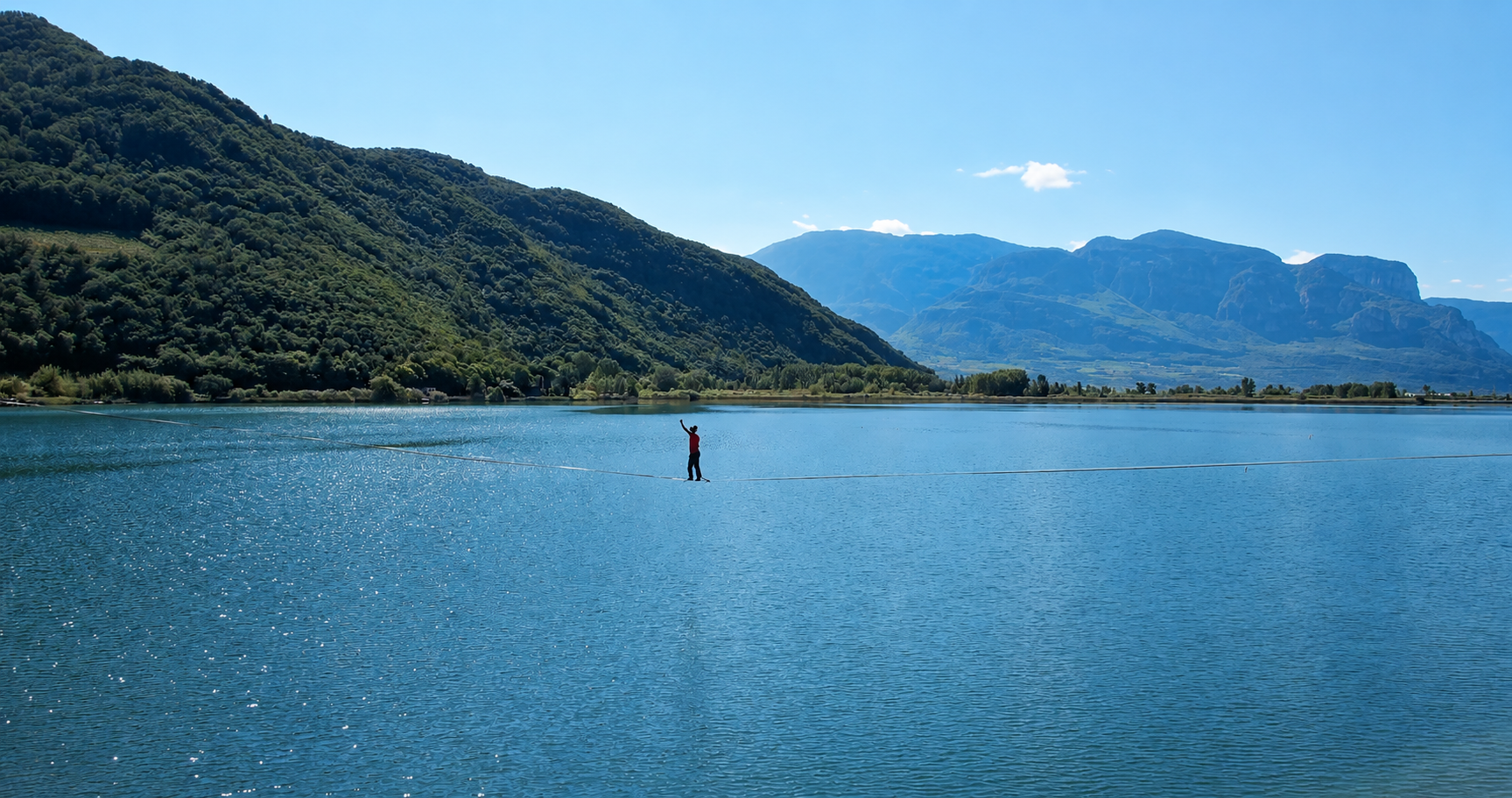
In May 2017, an international team of slackliners set the world record for the longest waterline—750 meters stretched across Lake Kaltern, the warmest lake in the Alps, in South Tyrol (Italy). This extraordinary project, organized in collaboration withthe Kaltern Tourist Office and Slacktivity, was not just about a sporting feat: above all, it was a major tourism promotion campaign for this little-known wine-growing region south of the Brenner Pass.
The goal: to put Kalterer See on the map
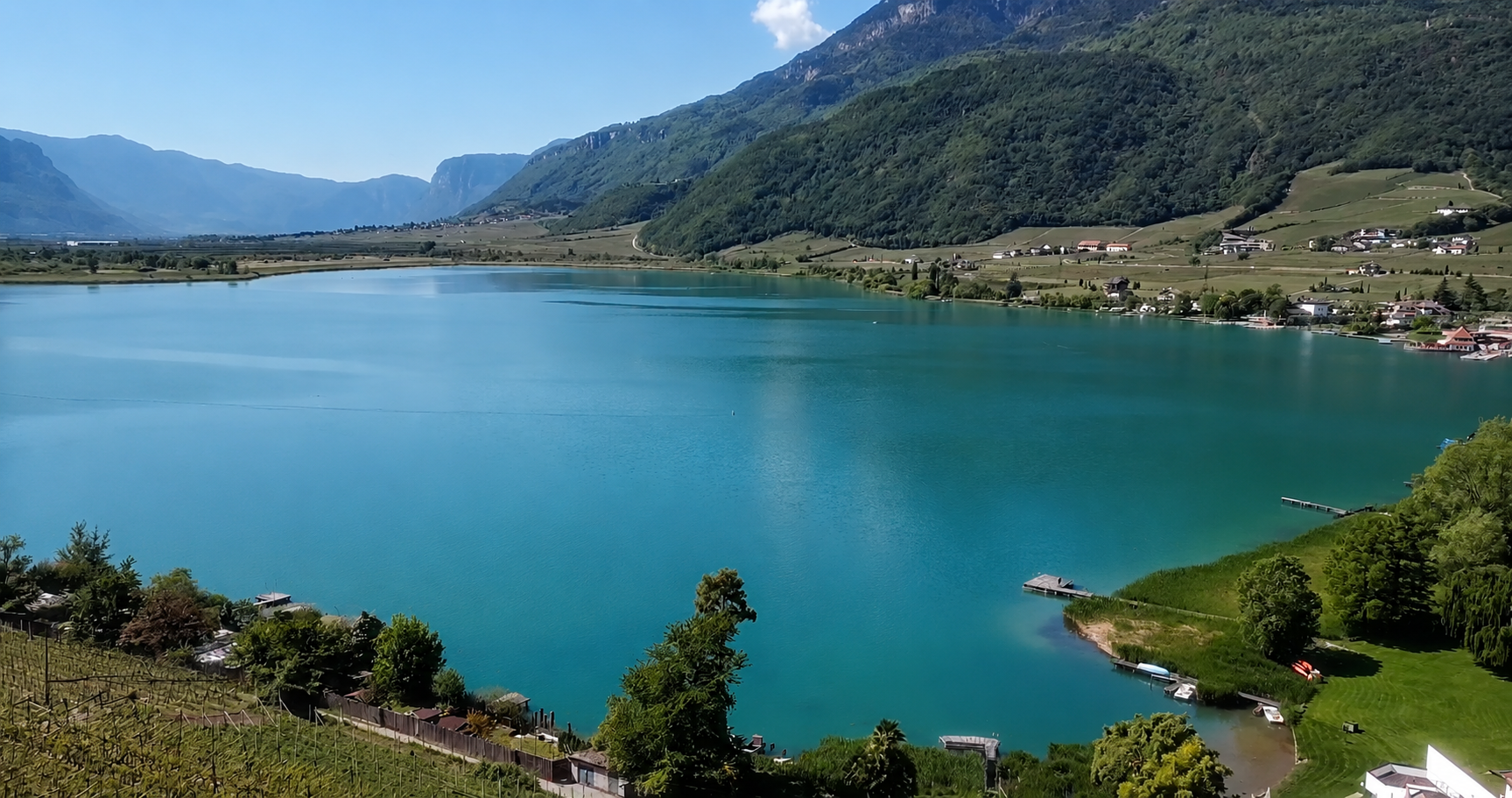
The Kaltern Tourist Office was looking for a marketing tool capable of generating national and international visibility for the lake. Lake Kaltern is the warmest lake in the Alps—a strong selling point, but one that is little known outside the region. A world record that is filmed and broadcast is exactly the kind of content that can change that.
The spectacular waterline naturally fits the brief: the image speaks for itself, the story behind the challenge attracts media attention, and social media does the rest.
Background and challenges: 750 meters, two cranes, one boat
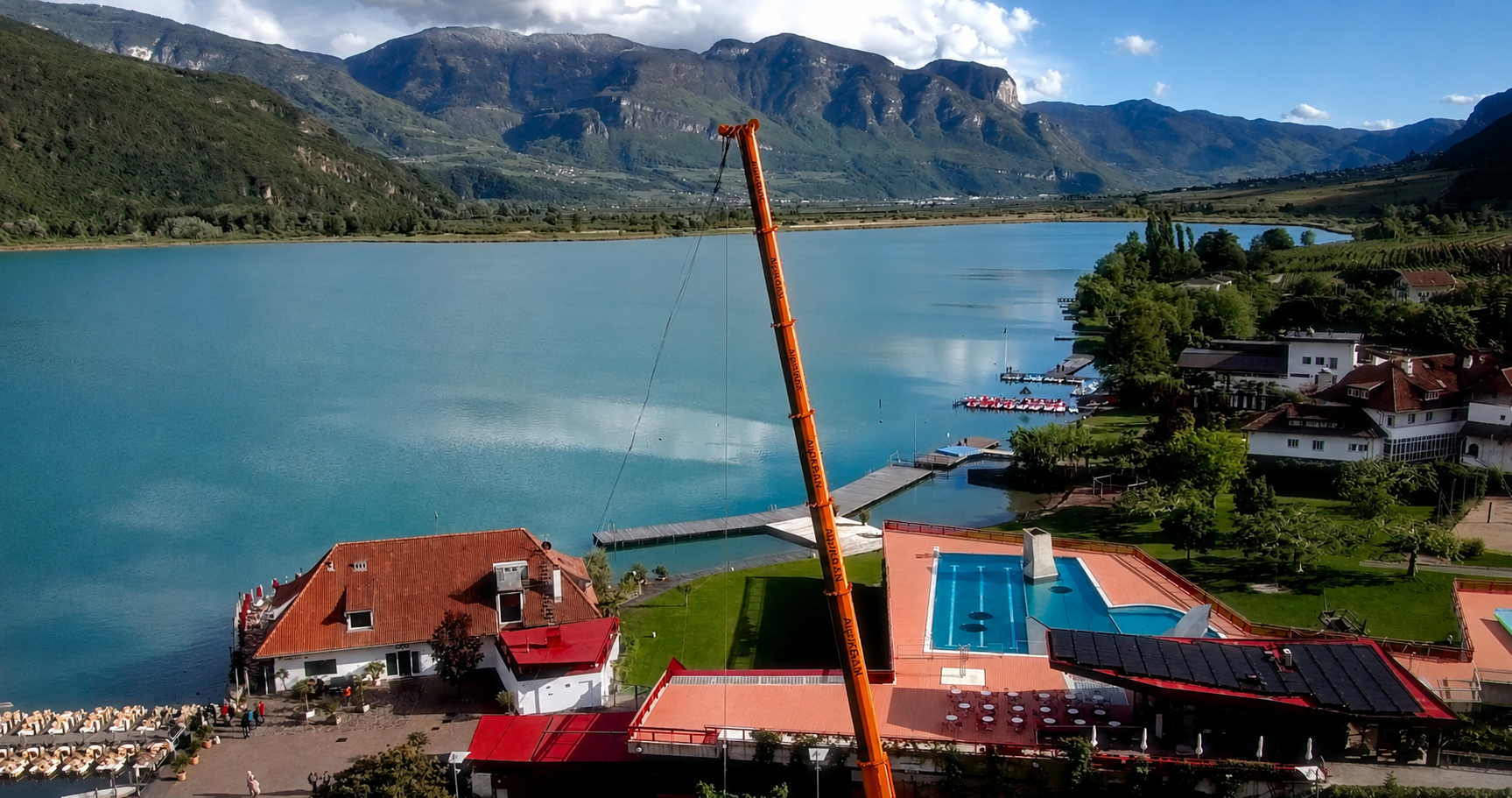
Lake Kalterer See is about 850 meters wide at its widest point. The original plan was to cross the entire lake—but the technical challenge was considerable.
First constraint: there was no natural elevation available on either shore. The solution chosen: install a 50-ton crane on each side of the lake, to be used as anchor points for the strap.
Second challenge: transporting 750 meters of webbing from one bank to the other. Local firefighters helped transport the line by boat. But a webbing of that length cannot simply be laid on the surface—it would sink and become tangled. Plastic bottles were attached every ten meters along the entire length to keep the line afloat during the crossing.
This kind of logistics—hours of preparation for a setup that no one sees but on which everything depends—is typical of waterline projects of this scale.
The team and the attempt
The team assembled for this record attempt was international:
Benjamin Kofler — local slackliner, South Tyrol
Lukas Irmler — Bavaria, Germany, one of the world's most successful waterline athletes
Samuel Volery — Switzerland, elite athlete
Tijmen van Deeren — Netherlands
All the athletes attempted the crossing. For the record to be validated, the rule is strict: they must cross the entire course without falling. A momentary lapse in concentration—even a brief one—and they have to start all over again.
The attempt was successful: the 750-meter waterline across Lake Kaltern has been certified as a Water Midline world record, using Slacktivity equipment.
Results and benefits for the region
For the Kaltern Tourist Office, the impact was immediate. Images of the lake spanned by a 750-meter slackline, held in place by two massive cranes on either side of the water, generated media coverage in Germany, Italy, and Austria, which was then shared by the international slackline community.
Beyond the record itself, the project has established Kalterer See as an exceptional venue for extreme sports—a destination that takes risks, innovates, and attracts visitors. This kind of impact is hard to achieve through traditional advertising channels.
For other examples of slackline shows and performances used as part of a communication strategy, see also the aerial show for ski resorts or the performance in Verbier for the Family Festival.
Tips for Organizers
Are you planning a project in an unusual location—such as a body of water, an urban setting, or an unexpected environment? Here’s what you need to consider before launching an installation of this type:
1. Start with the technical feasibility of the site. The width of the body of water, the available height along the shore, and accessibility for heavy machinery are the deciding factors. At Kalterer See, the lack of natural height necessitated the use of two 50-ton cranes—a decision that shaped the entire project.
2. Involve local partners from the very beginning. The fire department played a key role in transporting the cable by boat. This type of cooperation with local agencies isn’t optional—it’s essential.
3. Plan ahead for permits. Whether it involves using cranes on public roads or along a lake, flying over a body of water, or securing the perimeter, each country and region has its own requirements. In South Tyrol, as in France or Switzerland, administrative delays can easily push the schedule back by several weeks.
4. Plan the content well in advance. A world record is only valid if it is documented. Camera angles, the video crew, and the broadcast plan—these elements are just as much a part of the project as the technical setup.
5. Set a backup date. With this type of project, the weather is the main risk factor. It is always a good idea to have a backup date.
Is your project located on a lake, a river, between two buildings, or in a setting that no one has yet imagined? Contact our team so we can explore together what’s possible.
FAQ
What is a waterline world record?
A waterline world record involves setting up the longest possible slackline over a body of water and crossing it from one end to the other without falling. In May 2017, the record was set at 750 meters over Lake Kalterer See in South Tyrol, using a setup known as a "Water Midline" and Slacktivity equipment.
Why are cranes used for a waterline of this length?
When there are no natural high points available along the shore—such as cliffs, rocks, or buildings—industrial cranes are used as anchor points. At Kalterer See, two 50-ton cranes were positioned on opposite sides of the lake. This is one of the few ways to install a power line over a body of water without any usable terrain.
How do you transport a 750-meter cable from one bank to the other?
The rope is transported by boat from one bank to the other. To prevent it from sinking or becoming tangled, plastic bottles are attached at regular intervals along its entire length to keep it afloat during the crossing. Once both ends are in place, the line is stretched taut between the anchor points.
What is the difference between a "Water Midline" and a standard waterline?
The midline is a line with a tension and sag profile different from that of a conventional longline, designed for extreme lengths. It helps manage the oscillations and weight of the line over distances spanning several hundred meters above the water.
What kind of event would justify this type of project?
This type of installation is well-suited for regional tourism promotion strategies, visually striking brand communication campaigns, or events aimed at generating broad and lasting media coverage. Lake Kalterer See is a prime example: the record helped raise international awareness of this lake in South Tyrol.
Are special permits required for this type of installation?
Yes. Depending on the country and the type of body of water, permits from local authorities, technical departments, and sometimes water sports authorities or civil protection agencies are required. The involvement of the local fire department in transporting the slackline and the presence of cranes on the banks also require specific approvals. Slacktivity and Slackline Events their clients with these procedures.
Can a record attempt be combined with a public event?
Yes. The record attempt can be part of a broader program— introductory slacklining workshops, acrobatic demonstrations, and family-friendly activities. This is often the most effective way to maximize the local impact and media coverage of such a project.
What other ambitious projects Slackline Events completed?
Among our projects: a show for the 10th anniversary of the Aéroscopia Museum in Toulouse, a highline for Museum Night in Lausanne, and an event for the opening of the Forum Fribourg. See them all at slackline-events.com/case-studies.