

On Tuesday, July 21, 2026—the day of the time trial for Stage 16 of the Tour de France between Évian-les-Bains and Thonon-les-Bains—a highline was set up above the Town Hall square. This highline performance for the Tour de France in Thonon-les-Bains was commissioned bythe Thonon-les-Bains Tourist Office, which is now online under the name Thonon Léman Tourisme. Slackline Events, a Swiss highline performance company based in Veytaux, near Montreux, installed the line between a window of City Hall and the attic of the building across the street, about 15 meters above the ground.
In short
- Client: Thonon-les-Bains Tourist Office (SPL Destination Thonon), tourist office
- Agency: none; works directly with the office
- Location: Place de l'Hôtel de Ville, Thonon-les-Bains (Haute-Savoie), France
- Date: Tuesday, July 21, 2026, the day of the 16th stage of the 2026 Tour de France, a 26.1-km individual time trial
- Event type: entertainment event held in conjunction with a stage of the Tour de France
- Service: Highline performance (1 artist), including setup and safety management, and artistic direction
- Installation: On the Town Hall side, a triangular aluminum truss mounted in a third-floor window; on the building side, a wooden roof beam in the attic
- Length: 40-meter line (54 meters from anchor to anchor)
- Height: about 15 m above the square
- Tension: 2.45 kN (base), 5 kN (peak)
- Agreed format: 20-minute time slots with breaks during the race (first start at 1:00 p.m., last finish scheduled for 5:50 p.m.)
- Audience: VIP area set up on the Town Hall Square
- Costume: red-polka-dot leotard with straps
- Team: 1 artist, Bruno Toso del Valle (technical director), and Lyell Grünberg (artistic director)
The highline performance above the Town Hall square in Thonon-les-Bains on July 21, 2026. Video: Slackline Events.
Goals: A highline show for the Tour de France in Thonon-les-Bains
The tourist office wanted a high-visibility event on the day of the time trial that would showcase Thonon-les-Bains, its activities, and its heritage. The initial idea was a line stretching across Lake Geneva. After further study, the project shifted its focus to the city center.
The specifications were clear: a simple installation, stretched between two existing structures, anchored to city buildings whenever possible to simplify the permitting process, and a display visible from the VIP area set up on the square.
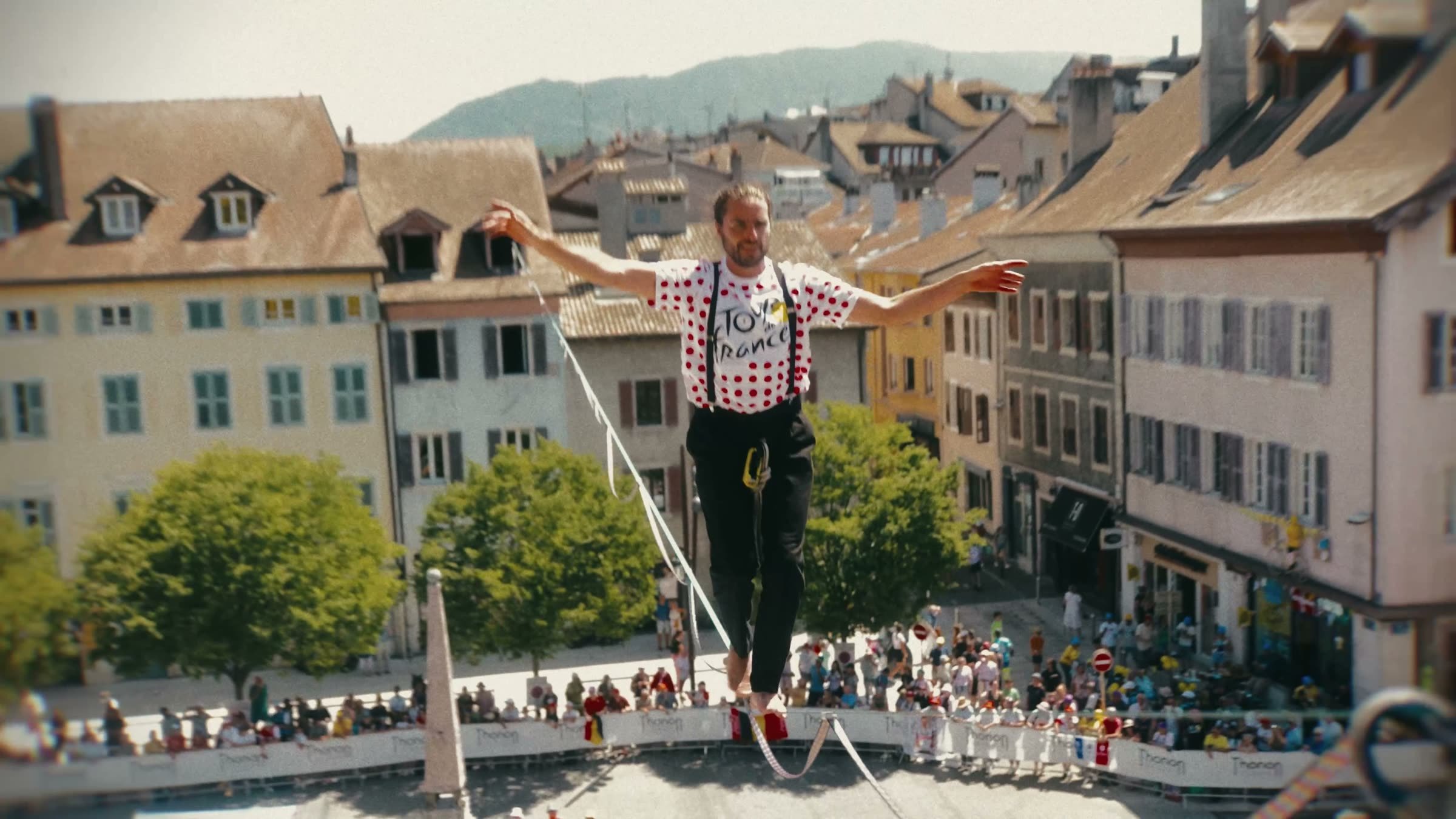
About 15 meters above the Town Hall Square, on July 21, 2026. Photo: Slackline Events
Background and Challenges: One Stopover City, Two Buildings, Three Months
Stage 16 of the 2026 Tour de France was a 26.1-km individual time trial between Évian-les-Bains and Thonon-les-Bains, held on July 21. According to France 3 Auvergne-Rhône-Alpes, the first rider started at 1:00 p.m., and the last was expected to finish at 5:50 p.m.
The project began in mid-April 2026, three months before the event. The exact location of the line was to be communicated to the television broadcast director by June 8. Since the Town Hall square was considered “landlocked” for the helicopter, Slackline Events requested that the location be reported to the director so he could station a cameraman there.
Following the site survey on June 3, 2026, three locations were compared: the Town Hall Square, a large thoroughfare between the Belvédère and Jules Ferry Avenue, and the Rives Wharf. The latter two required an additional elevated point. The office selected the Town Hall Square, as it was the simplest option in terms of obtaining permits.
The two anchor buildings have nothing in common. The Thonon-les-Bains City Hall, a neoclassical building rebuilt beginning in 1821 after the fire of 1815, has had its facade facing the square and its corresponding roof listed as historic monuments since November 30, 1972. Across the street, the building at 6 Place de l’Hôtel de Ville was vacant and undergoing extensive renovation, with its exposed roof structure.
The final hurdle: two separate permits. The city could only issue a permit for the City Hall portion, since the building across the street does not belong to the municipality. Both permits were granted on July 17, 2026, four days before the event.
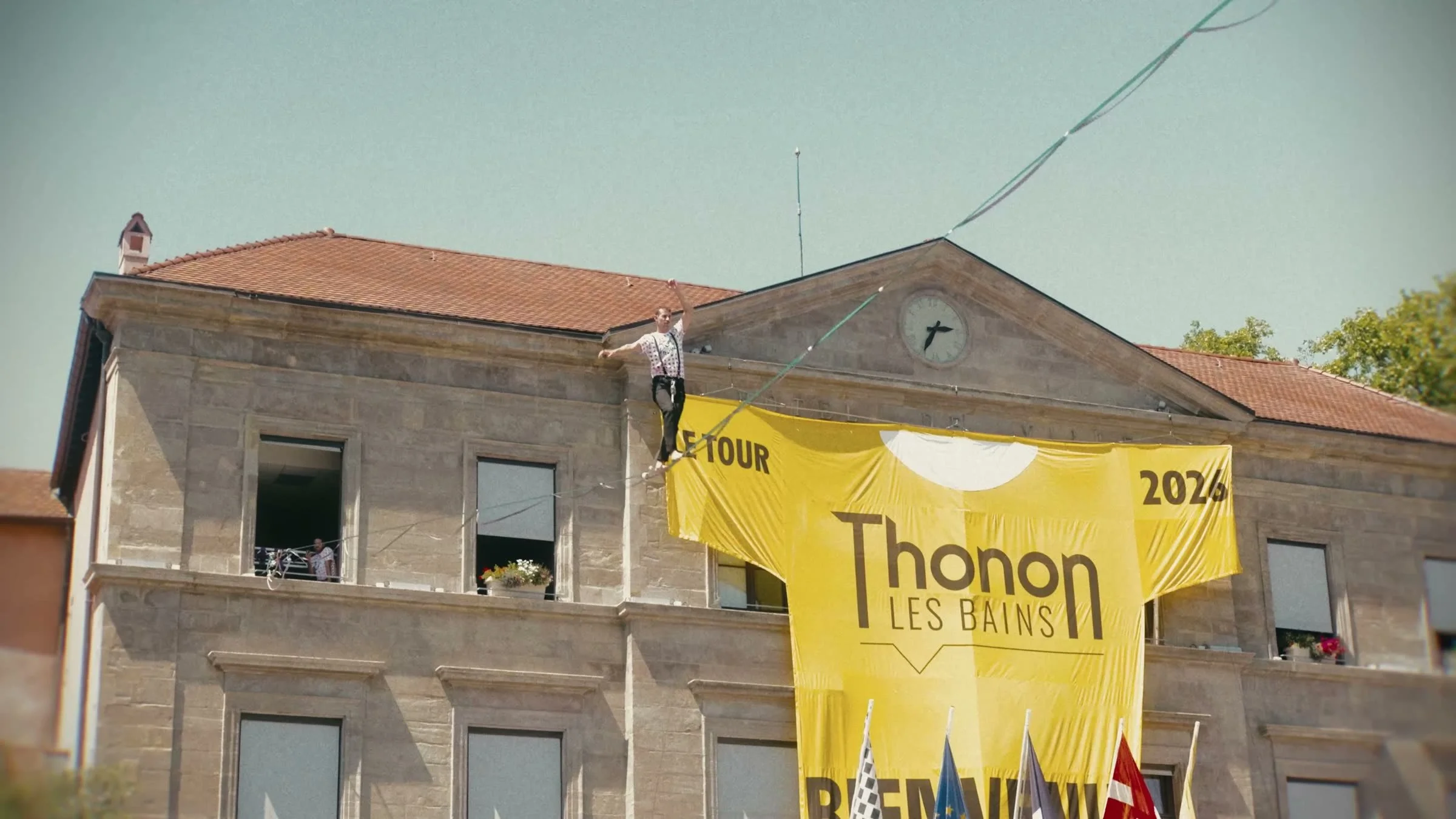
The route starts at a window in City Hall and passes in front of the city's giant yellow jersey. Photo: Slackline Events
Our solution: a truss in the Town Hall window, a roof beam across from it
Slackline Events managed the project from start to finish: site scouting, technical documentation, permit applications, installation, safety, and artistic direction. Our technical manager, Bruno Toso del Valle, conducted the site scouting on June 3, 2026, followed by a technical inspection on July 3 at City Hall and the building across the street.
At City Hall: a truss installed in a third-floor window
On the Town Hall side, a 3-meter-long aluminum triangular truss (with 30-centimeter sides) is positioned across a third-floor window in the first southwest-facing room on the side facing the square. It rests against a 70-centimeter-thick load-bearing wall, which transfers the load to the structural walls. A protective layer and load-distributing pads limit the pressure on the wall. The artist enters and exits the line, always on the Town Hall side.
Building-related: a wooden structural beam
On the building side, the main anchor is attached to a 13 × 27 cm wooden structural beam embedded in the wall. The sling is positioned as close as possible to the embedded section to minimize beam deflection. A second beam (19 × 33 cm) serves as a vertical deflection point.
A 40-meter line about 15 meters above the ground
The line is 40 m long (54 m from anchor to anchor) and runs about 15 m above the square. Its base tension is 2.45 kN (250 kgf), with a peak load of 5 kN (510 kgf). The equipment includes a webbing with a breaking strength of 25 kN, a backup rope, and a dynamometer.
20-minute time slots based on the race
It wasn't possible to broadcast continuously throughout the five-hour race. The organizing committee and Slackline Events therefore scheduled 20-minute segments with breaks, until around 5:00 p.m., when the broadcast focused on the final runners. Setup was scheduled to begin at 7:30 a.m., with tests and a rehearsal in the late morning, and takedown was scheduled to begin at 6:00 p.m.
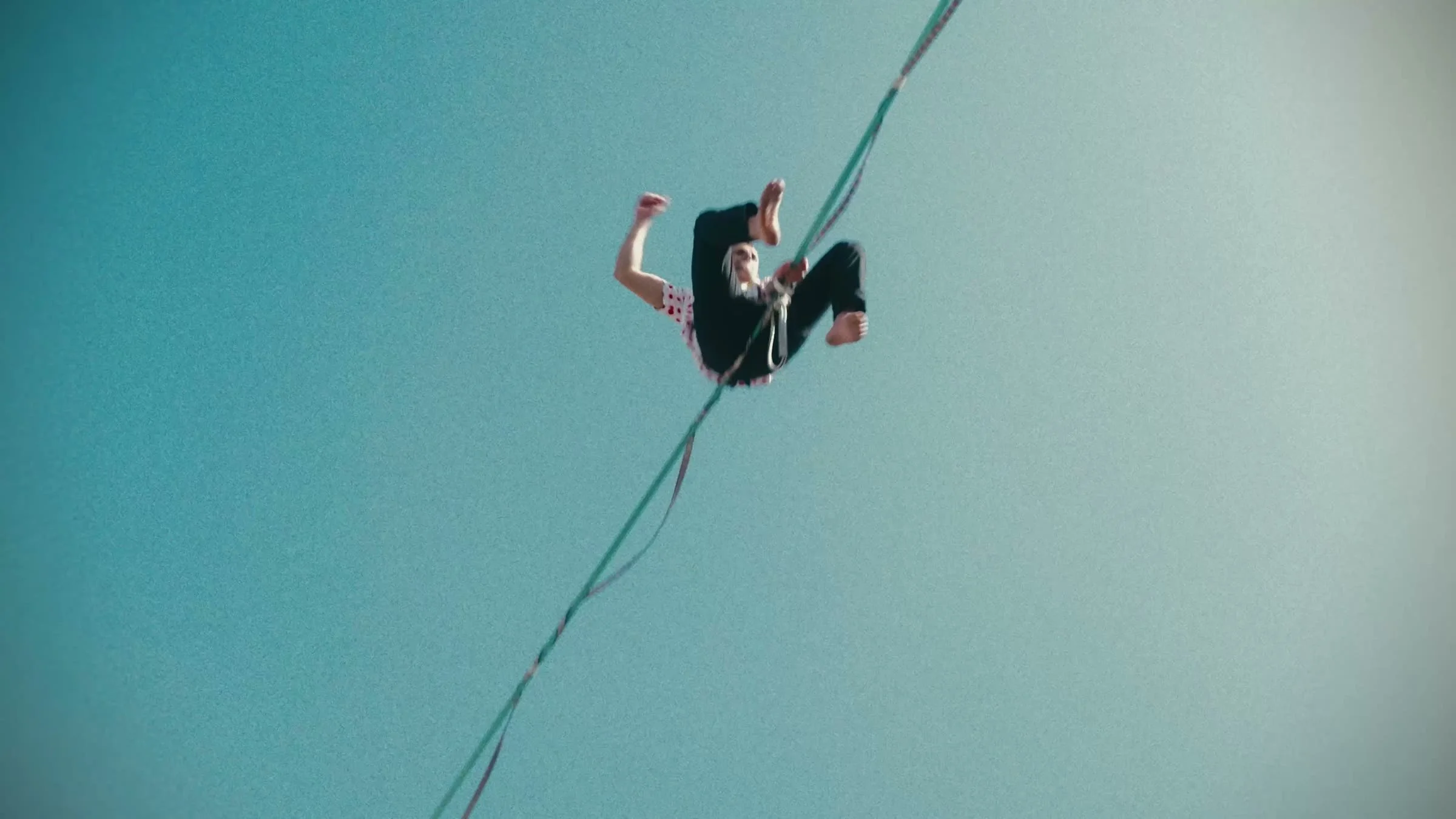
Between two crossings, tricks on the strap. Photo: Slackline Events
Highlights: the square, City Hall, and the race
The highline show in Thonon-les-Bains was designed around a single image: the artist on a " Slackline Events " approximately 15 meters above the square, between the facade of City Hall and the attic of the building across the street, on the day of the time trial. The show was primarily intended for guests in the VIP area set up on the square.
For the occasion, the artist wore a red-polka-dot jersey—a nod to the best climber’s jersey—with shoulder straps. Below the line, the time trial riders passed between the barriers, in front of a crowd gathered along the course. On the facade of City Hall, a giant yellow jersey in the colors of Thonon-les-Bains completed the scene. Between runs, the artist performed a series of tricks on the strap, lying down or suspended beneath the line.
On the same day, according to Wikipedia, Remco Evenepoel won the stage in 32 minutes and 19 seconds, ahead of Tadej Pogačar, who retained the yellow jersey.
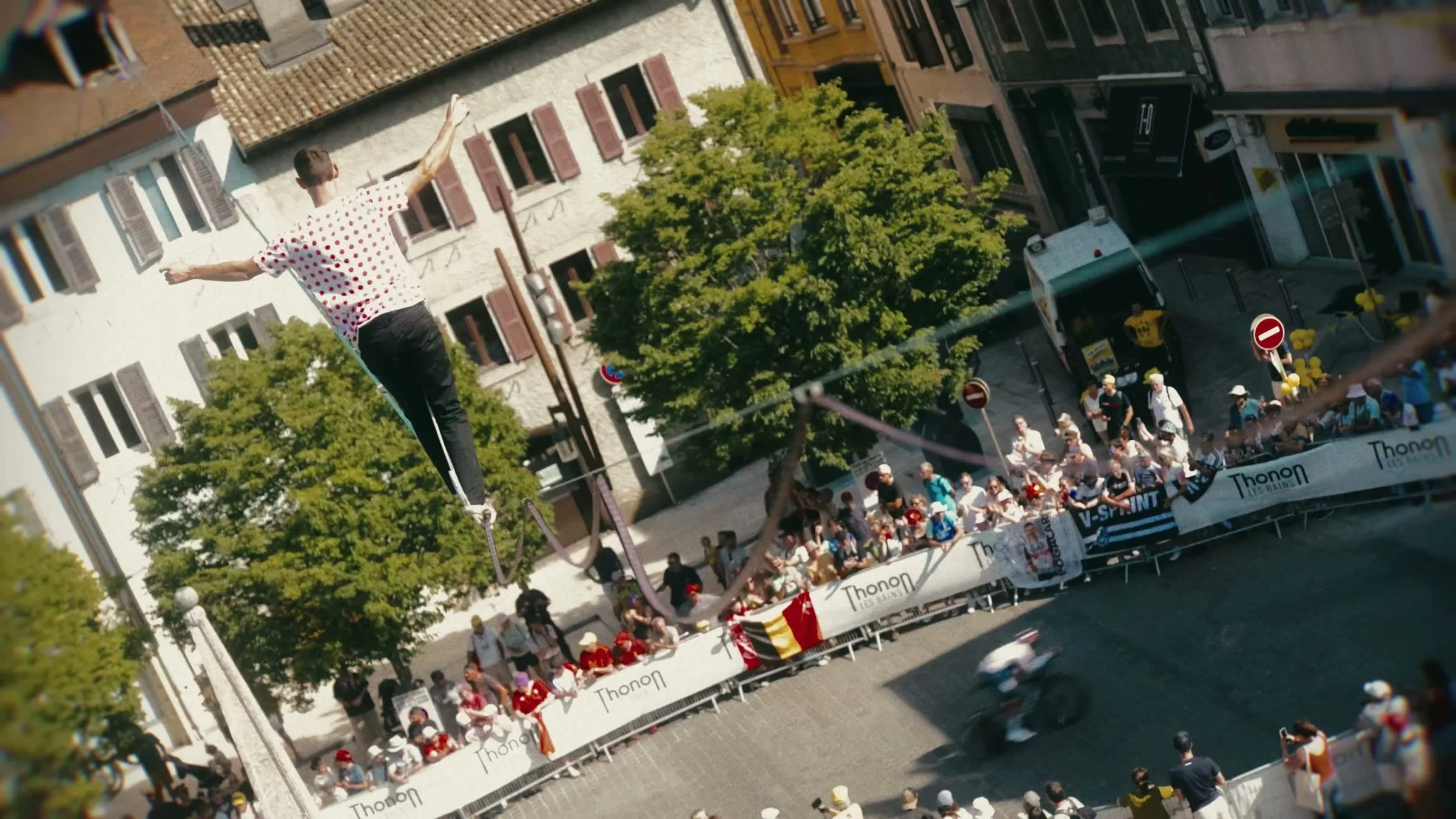
A time-trial rider crosses the finish line. Photo: Slackline Events
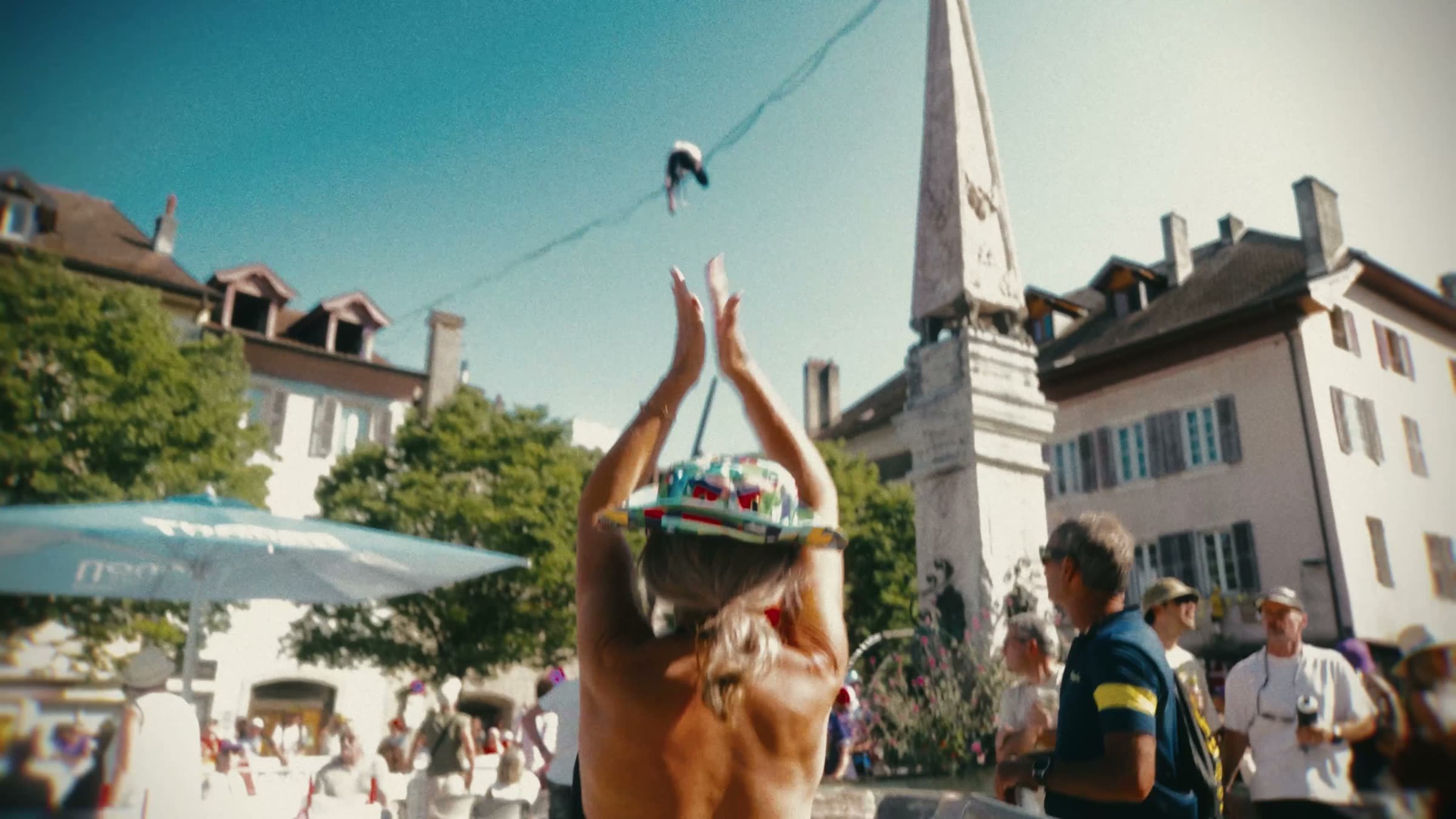
In the square, the audience applauds the artist. Photo: Slackline Events
Results and Impact: An Installation Approved by the City and the Property Owner
The Thonon-les-Bains highline was successfully installed and unveiled on Tuesday, July 21, 2026, and dismantling was completed by early evening. The installation was based on two written agreements: one with the City of Thonon-les-Bains regarding the City Hall section, and another with the owner of the building across the street. Today’s photos show a large crowd gathered along the barriers on the square, beneath the line.
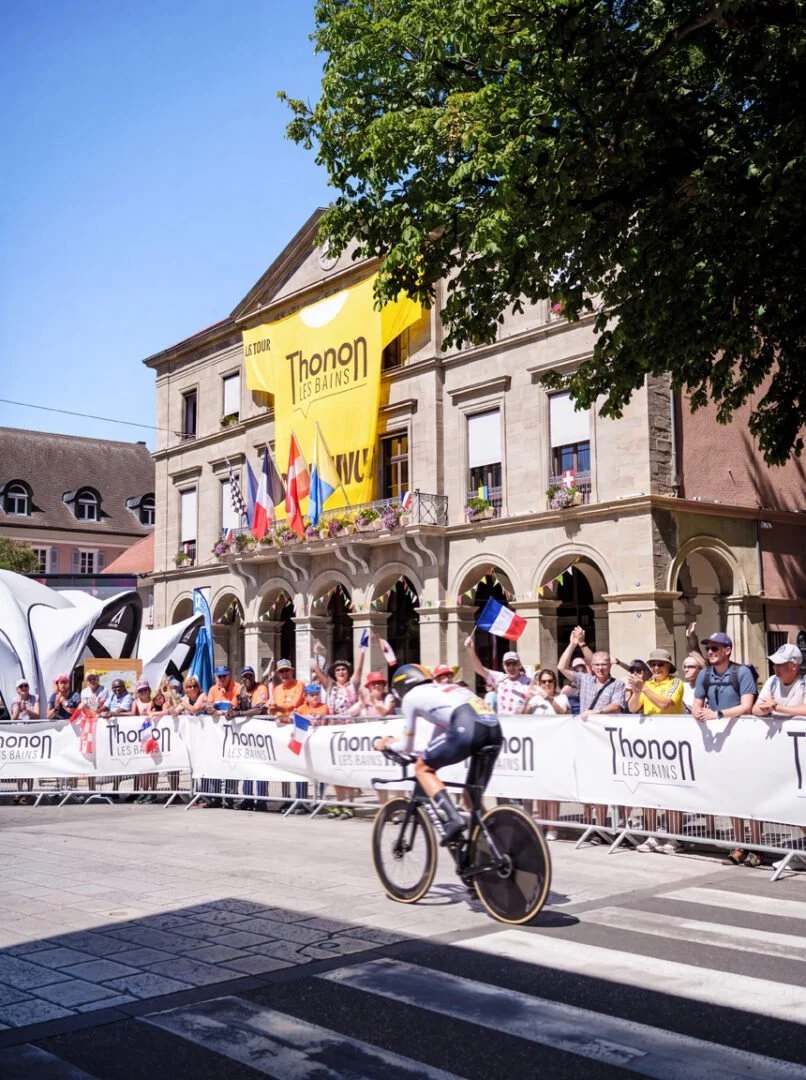
The time trial route passes in front of City Hall and its giant yellow jersey. Photo: Thonon-les-Bains Tourist Office
This project joins other performances in the city center, such as the highline strung between two buildings in Sion or the slackline show in Sion, which aim to highlight Valais’s heritage. For another sporting event, see the slackline show at the Ski World Cup in Crans-Montana.
Tips for Organizing a Highline Show in a Stopover City or During a Race
- Obtain written consent from each property owner. A line between two buildings requires two permits: in Thonon, one from the city on one side and one from a private property owner on the other.
- Survey the interior of buildings. A survey from the street is not enough: you need to see the window, the load-bearing wall, and the roof structure.
- Have a Plan B for each anchor point. An occupied building or an inaccessible structure may make anchoring impossible: plan for an alternative as soon as you identify the location.
- Don't aim for a nonstop show. Twenty-minute segments with breaks work better over the course of a five-hour race.
- Notify the TV production team well in advance. In order for the route to be filmed, the production team must know its exact location well before the race: in Thonon, before June 8 for a stage on July 21.
- Plan for equipment access. If the route is closed to cars, arrange a nearby drop-off point with the organizer.
- Bring your own images. The images from official television belong to the broadcasters: plan your photos and video in advance.
Acknowledgments
Thank you tothe Thonon-les-Bains Tourist Office for its trust, and especially to Sarah Verdan, communications and events manager, who saw the project through from the initial idea to the big day. Thank you to the City of Thonon-les-Bains for granting permission to use City Hall, and to the owner of the building across the street for granting permission as well. Photos and video: Slackline Events, except for the photo of the runner in front of City Hall (Thonon-les-Bains Tourist Office).
To follow the office: Thonon Tourisme on Instagram.
Let's discuss your project
Are you hosting a race stage, a festival, or a town celebration, and looking for entertainment that can be seen from across the entire square? Slackline Events will assess the feasibility of your venue and propose a custom highline performance for your town. You can request a quote on this page, learn about all our slackline services, or browse our other case studies.
Frequently Asked Questions: A Highline Show in a Tour de France Stage Town
What kind of entertainment should be offered in a stage town on the Tour de France?
A highline stretched between two buildings in the city center is an attraction visible from across the entire square, without taking up any space on the ground. In Thonon-les-Bains, on July 21, 2026, Slackline Events set up a 40-meter line approximately 15 meters above the Place de l’Hôtel de Ville, with 20-minute time slots scheduled for the time trial. Details about this type of performance can be found on our highline performance for events page.
Is it possible to set up a highline from the window of a city hall?
Yes, if the building's structure allows it and if the municipality grants permission. In Thonon-les-Bains, a 3-meter aluminum triangular truss was installed across a third-floor window. It rests on a 70-centimeter-thick load-bearing wall, with a protective layer and load-distributing footings. Each installation is approved after inspection by our technical manager.
How do you anchor a highline to a building's roof structure?
The line is secured to a wooden structural beam embedded in the wall, and the sling is positioned as close as possible to the embedment to minimize deflection. In Thonon-les-Bains, the main anchor point was a 13 × 27 cm beam, with a second 19 × 33 cm beam serving as a vertical deflection point. The structure and access are inspected during the site survey.
What permits are required to set up a highline over a public square?
The consent of every owner of the buildings where the line is anchored is required. In Thonon-les-Bains, the city could only grant permission for the Town Hall section, since the building across the street does not belong to the municipality. Both consents were received on July 17, 2026, four days before the stage.
How do you fit a highline performance into a time trial that lasts several hours?
It is broken up into short segments, with breaks in between. In Thonon-les-Bains, the race lasted from 1:00 p.m. to 5:50 p.m., and a continuous five-hour broadcast was not possible. The tourist office and Slackline Events opted for 20-minute segments, until around 5:00 p.m., when the broadcast focuses on the final riders.
What is the tension on a 40-meter highline?
In Thonon-les-Bains, the base tension was 2.45 kN (approximately 250 kgf), with a peak expected to reach 5 kN (approximately 510 kgf). The equipment includes a dynamometer to monitor it. This value is specific to this installation: it varies depending on each line.