

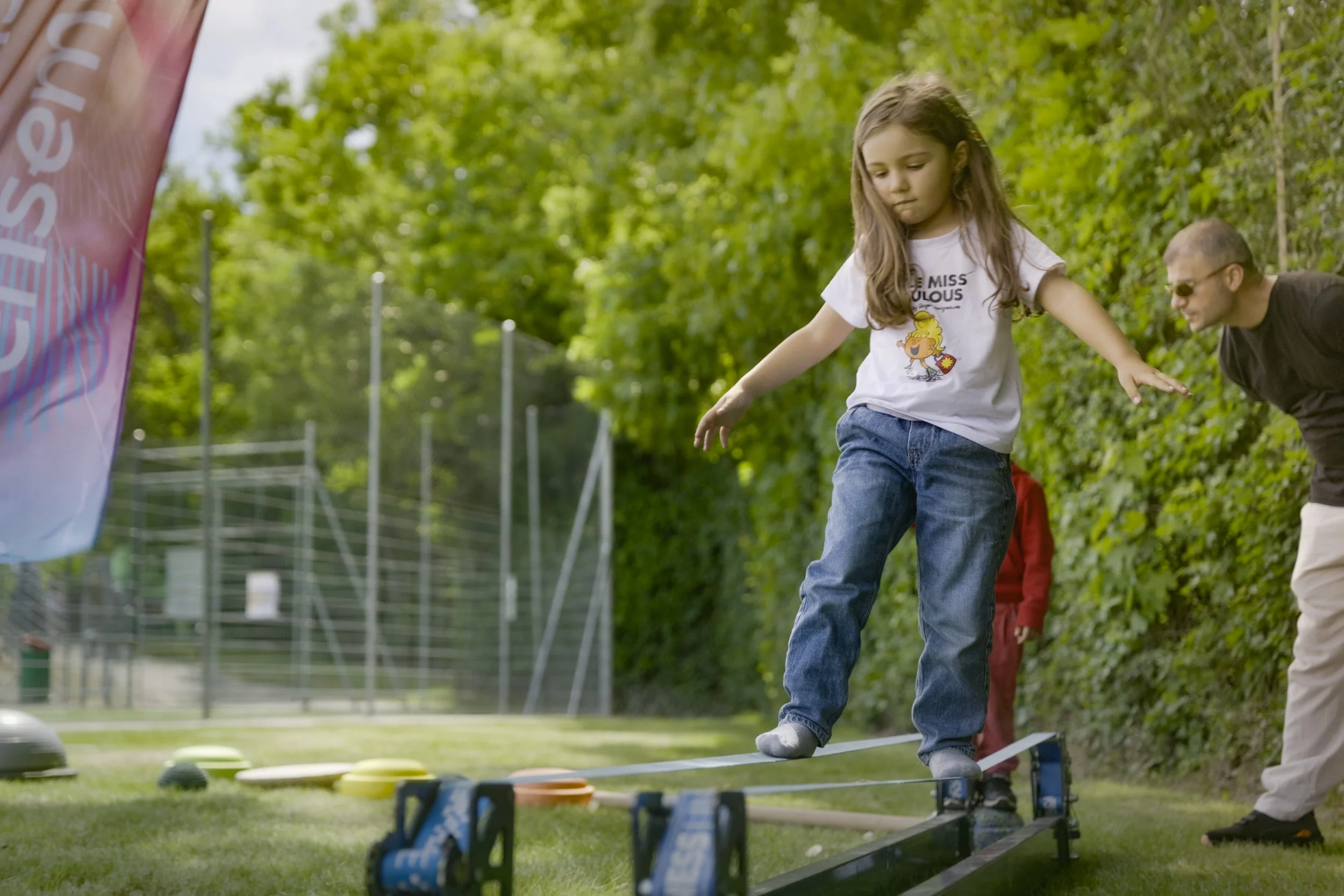
On May 9 and 10, 2026, Slackline Events up its slackline workshop at the Stade des Tattes in Onex as part of “Onex, City of Movement,” the third event in the festivities marking the 175th anniversary of the municipality of Onex. The slackline workshop was open to all ages, required no registration, and was designed as a self-contained, fluid activity for families. The event was coordinated by Agnès and Véronique, independent representatives of Lunafilms.ch on behalf of the Onex 175th Anniversary Association, which is overseeing the six events scheduled from November 2025 to November 2026.
A sports workshop at the heart of Onex’s 175th anniversary
Onex became an independent municipality on November 1, 1851, after separating from Confignon. One hundred and seventy-five years later, the City of Onex is celebrating this independence through six major themed events: games, carnival, movement, arts, talents, and a town festival. The third event, “Onex, City of Movement,” was dedicated to sports and health, targeting families, amateur athletes, and local sports clubs.
For this weekend, the 175th Anniversary Association was looking for activities that could attract a large audience, run on a drop-in basis over two days, and create a real atmosphere rather than just a simple demonstration. It was in this context that our introductory slackline workshop was selected, to complement the soccer, skiing, and other activities taking place on site.
Why the slackline workshop was selected
Agnès, a co-organizer, explained two specific reasons for choosing Slackline Events another provider.
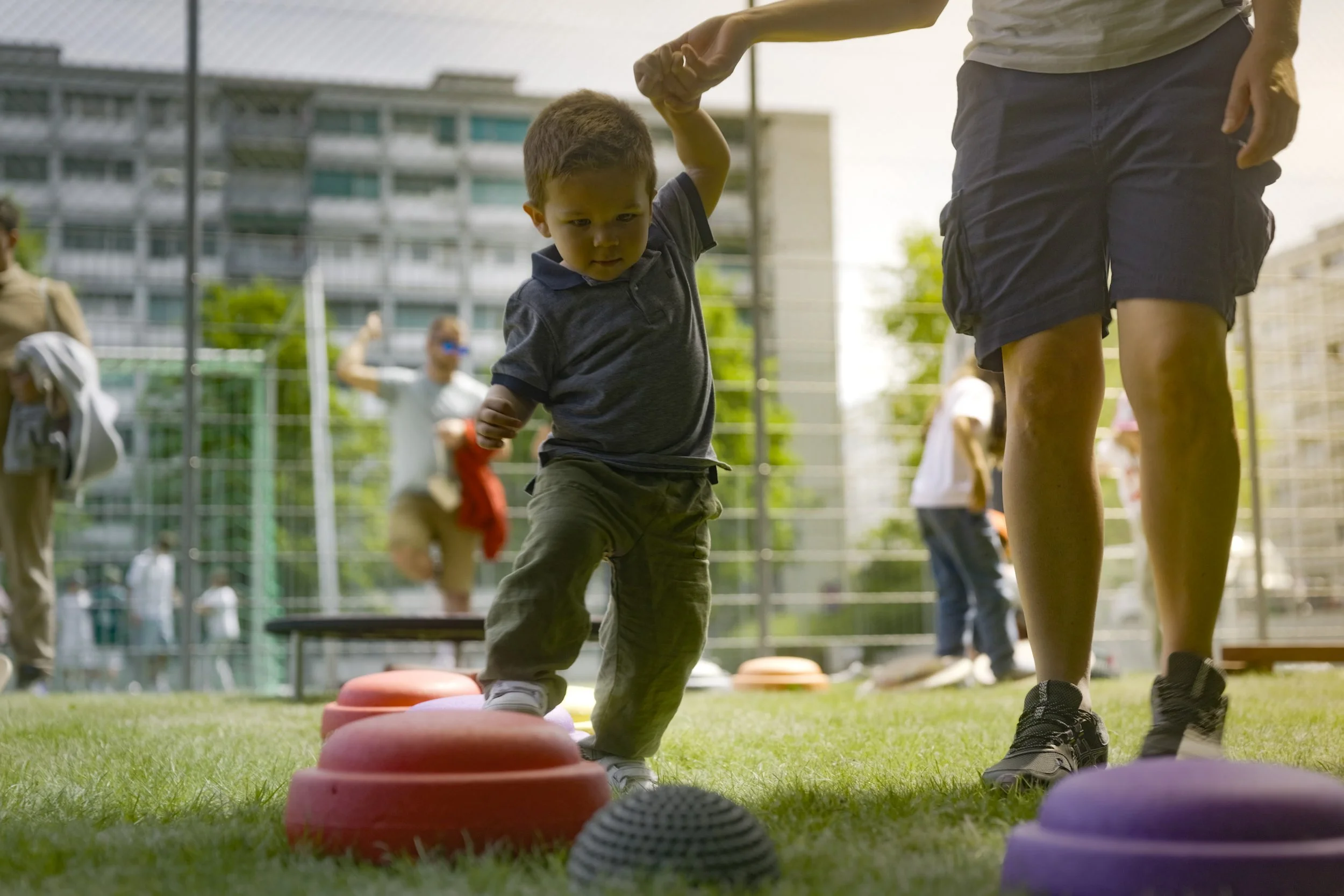
First, the workshop is designed for all ages. The large slacklines are suitable for teens and adults; the smaller lines are sized for children and grandparents; and a balance course is set up for toddlers. This age-based segmentation is rarely offered in the event-based sports activities market, and it’s a key factor when the event targets multigenerational families. Agnès also mentioned that she had expected to receive only the main slacklines to walk on, and that she discovered the balance course for the youngest children once she arrived on site.
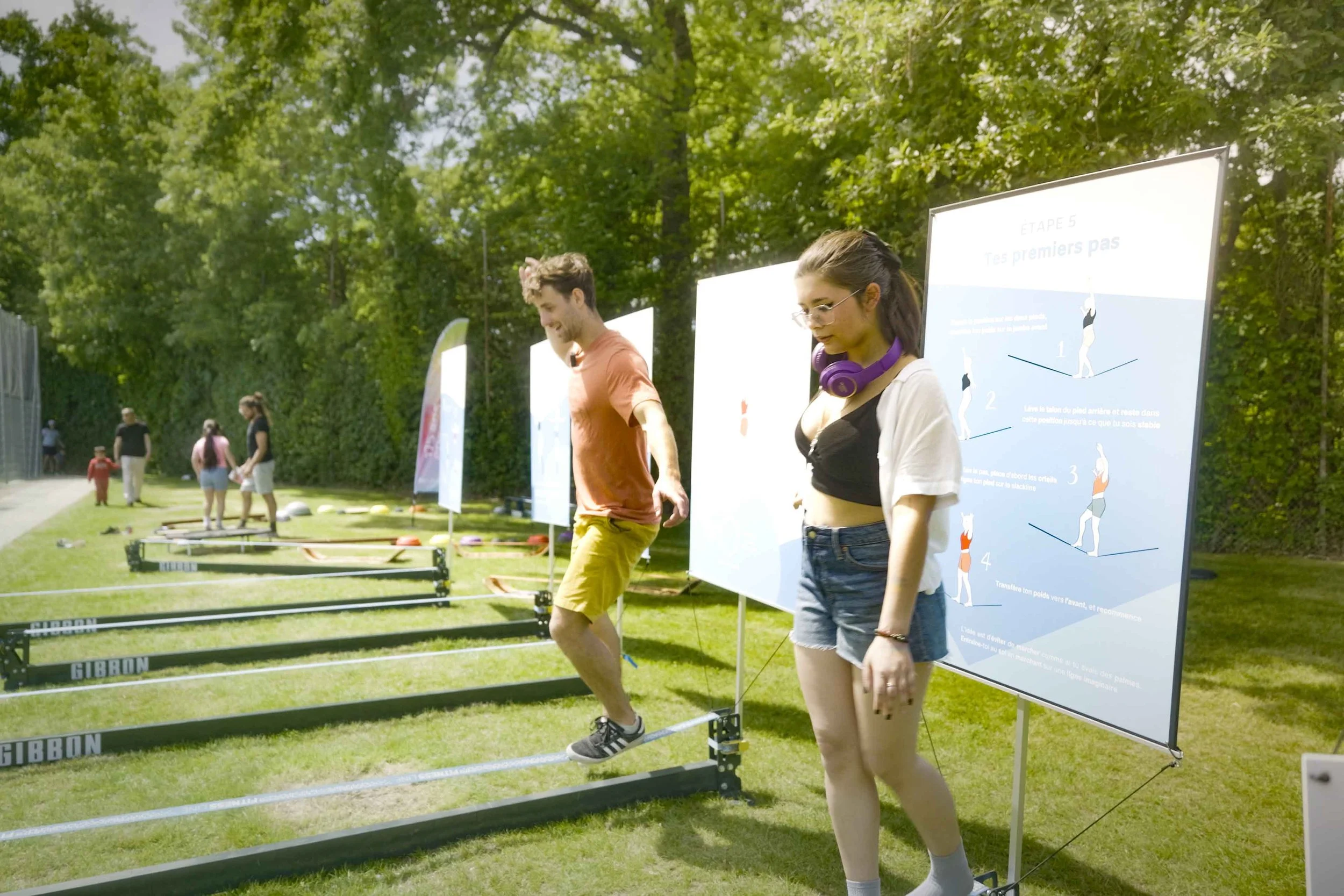
Next, Slackline Events unique teaching method Slackline Events on an interactive card set structured into five steps: the basic position with arms raised, stepping down on one foot, stepping down on both feet, taking the first steps, and finally walking fully. This visual progression allows participants to learn on their own, without tying up an instructor, and to track their progress card by card. As Agnès put it: “It’s great because you can be independent.”
A layout designed for free-flowing traffic
The facility at Stade des Tattes was designed to accommodate a steady flow of visitors over two days of free activities that require no registration. This lack of registration is intentional: it avoids long lines and fixed time slots, and allows everyone to come and try out the activities for as long as they like.
On the ground, the workshop consists of several courses set up in parallel, each tailored to a specific skill level and body type. Instructional charts are placed next to each course to guide participants through the progression. Our team is on hand to provide supervision and ensure safety, but learning takes place through independent discovery. Véronique, who tried it out on the morning of the event, reached the first stage (basic position) and noted that everything was “explained really well.”
For the organizers, this approach is a game-changer: the event runs smoothly without any intervention on their part. As Agnès noted, “You arrive, set everything up, and then you’re completely on your own. And it really brings the venue to life.”
The feature that worked best on the site
The organizers’ verdict was clear. Compared to the other sports activities offered over the weekend—including a ski jump and a soccer event—slacklining drew the most public engagement. Agnès herself identified several reasons for this result.
First, the organic nature of the event: with no registration or set rotation, participants can try it out continuously, creating a visually dynamic atmosphere that never stops. Second, the cross-generational appeal: it’s not just children participating while their parents watch. Adults get involved too, creating a rare intergenerational synergy at this type of event. Third, the playful nature: slacklining is still seen as an acrobatic and novel discipline by most participants, which sparks curiosity and a desire to try it.
At the end of the weekend, the 175th Anniversary Association of Onex has already renewed the partnership for the next event, “Onex, Scène des Arts,” scheduled for July 31 through August 2, 2026—this time featuring a performance on the afternoon of August 2.
Tips for organizers of community events
For municipalities, tourist offices, and agencies that organize open-access public events, several key principles emerge from the Onésian experience. Prioritizing activities that require no registration and have no fixed time slots maximizes engagement on long event days. Ensuring that an activity truly caters to all age groups—not just “family-friendly” in the marketing sense—makes the difference between an activity that people actually use and one they avoid. Ask whether the provider offers a structured teaching method rather than a simple “open tryout”: this is what makes the activity self-sustaining from the organizer’s perspective. And plan for floor space and perimeter safety, two factors often underestimated on synthetic turf fields.
For similar examples, see also our case studies on the FC Bulle slackline brunch and the Family Festival in Verbier, two events with intergenerational audiences that were organized using the same open-access approach.
Plan Your Event
Onex has chosen an introductory workshop. Other municipalities opt for a more spectacular format, such as an aerial highline performance or a slackline acrobatics show. The choice depends on the audience, the event duration, and the budget. To discuss your project or book a slot, you can email us at info@slackline-events.com or use our workshop booking interface. All our case studies from previous events are also available for you to review and compare formats.
FAQ — Slackline Workshops and Event Activities
What type of slackline should you choose for a community event?
For a community event open to the general public, the introductory workshop is the most suitable format. It welcomes participants of all ages on a drop-in basis, requires no registration, and runs for full days. The performance format (highline or acrobatic show) is better suited for a scheduled highlight or an opening ceremony. Both formats can be combined within the same event.
At what age can you start trying slacklining?
Suitable for children as young as 3–4 years old with an age-appropriate balance course, and with no upper age limit. Our facility features several courses tailored to different skill levels: a balance course for toddlers, low-level courses for children and seniors, and high-level courses for teens and adults. This is what sets an all-ages slackline workshop apart from a simple demonstration.
Can I participate in the slackline workshop without registering in advance?
Yes, that’s actually the format we recommend for open-access public events. Participants simply show up and try things out without making a reservation. This avoids lines, allows everyone to come back multiple times, and keeps the venue bustling with activity.
How does the flashcard learning method work?
The method breaks down the learning process into five visual steps: starting position, lowering onto one foot, lowering onto both feet, first steps, and then walking independently. Each card is displayed next to the corresponding line. Participants progress at their own pace without tying up an instructor, making the experience self-directed and self-paced.
What are the space and security requirements?
A large slackline requires approximately 15 to 20 meters of clear length and 3 meters of width, with a buffer zone around it. The lines are stretched between secure structures (trees with protective gear, dedicated structures, or ground anchors). The step height is limited to 30–50 cm in introductory workshops. Our team handles the setup, safety, and takedown from start to finish.
Can the workshop be set up on an artificial turf field?
Yes. The Stade des Tattes in Onex uses state-of-the-art synthetic turf, and installation is straightforward thanks to specialized anchors that do not damage the surface. Whether on natural grass, sand, gym flooring, or paved surfaces, specific anchoring solutions are available.
How many people can try it at the same time?
In a full-scale installation with 4 to 6 parallel lines, up to 20–30 people can be active at the same time (on the lines or on the balance course). On a public day with open access, several hundred participants can take part, as observed in Onex.
Is slacklining also suitable for adults at a family event?
Yes, and it’s actually a key selling point. Unlike many family activities where adults just watch, slacklining draws in parents and grandparents who end up giving it a try themselves. This is a sentiment shared by the organizers in Onex: “It’s not just parents watching their kids—everyone really gets involved.”
How much does a slackline workshop cost for a community event?
The price depends on the number of days, the number of lines installed, travel expenses, and the complexity of the site. For an estimated budget and a detailed quote, please submit your project through our booking interface or email us at info@slackline-events.com.
Can we combine a workshop with a performance?
Yes, that’s actually a common combination. The introductory workshop fosters active participation throughout the event, while the highline or acrobatic show serves as a scheduled highlight that draws media attention and crowds. This is the approach taken by the Onex 175th Anniversary Association, which scheduled a workshop in May followed by a show in early August.
What similar events Slackline Events organized in the past?
Slackline Events regularly Slackline Events to municipalities, tourist offices, and corporate events. Examples include the Family Festival in Verbier, Museum Night in Lausanne, the Heritage Show in Sion, and entertainment at ski resorts.
How do we book a slackline workshop for our event?
The quickest way is to use our online booking interface, which generates an instant quote based on your specifications. For complex events or performances, please contact us directly by email at info@slackline-events.com so we can work with you to finalize the details.
Double-click to edit...
Tips for organizers of community events
For municipalities, tourist offices, and agencies that organize open-access public events, several key principles emerge from the Onésian experience. Prioritizing activities that require no registration and have no fixed time slots maximizes engagement on long event days. Ensuring that an activity truly caters to all age groups—not just “family-friendly” in the marketing sense—makes the difference between an activity that people actually use and one they avoid. Ask whether the provider offers a structured teaching method rather than a simple “open tryout”: this is what makes the activity self-sustaining from the organizer’s perspective. And plan for floor space and perimeter safety, two factors often underestimated on synthetic turf fields.
For similar examples, see also our case studies on the FC Bulle slackline brunch and the Family Festival in Verbier, two events with intergenerational audiences that were organized using the same open-access approach.
Plan Your Event
Onex has chosen an introductory workshop. Other municipalities opt for a more spectacular format, such as an aerial highline performance or a slackline acrobatics show. The choice depends on the audience, the event duration, and the budget. To discuss your project or book a slot, you can email us at info@slackline-events.com or use our workshop booking interface. All our case studies from previous events are also available for you to review and compare formats.
FAQ — Slackline Workshops and Event Activities
What type of slackline should you choose for a community event?
For a community event open to the general public, the introductory workshop is the most suitable format. It welcomes participants of all ages on a drop-in basis, requires no registration, and runs for full days. The performance format (highline or acrobatic show) is better suited for a scheduled highlight or an opening ceremony. Both formats can be combined within the same event.
At what age can you start trying slacklining?
Suitable for children as young as 3–4 years old with an age-appropriate balance course, and with no upper age limit. Our facility features several courses tailored to different skill levels: a balance course for toddlers, low-level courses for children and seniors, and high-level courses for teens and adults. This is what sets an all-ages slackline workshop apart from a simple demonstration.
Can I participate in the slackline workshop without registering in advance?
Yes, that’s actually the format we recommend for open-access public events. Participants simply show up and try things out without making a reservation. This avoids lines, allows everyone to come back multiple times, and keeps the venue bustling with activity.
How does the flashcard learning method work?
The method breaks down the learning process into five visual steps: starting position, lowering onto one foot, lowering onto both feet, first steps, and then walking independently. Each card is displayed next to the corresponding line. Participants progress at their own pace without tying up an instructor, making the experience self-directed and self-paced.
What are the space and security requirements?
A large slackline requires approximately 15 to 20 meters of clear length and 3 meters of width, with a buffer zone around it. The lines are stretched between secure structures (trees with protective gear, dedicated structures, or ground anchors). The step height is limited to 30–50 cm in introductory workshops. Our team handles the setup, safety, and takedown from start to finish.
Can the workshop be set up on an artificial turf field?
Yes. The Stade des Tattes in Onex uses state-of-the-art synthetic turf, and installation is straightforward thanks to specialized anchors that do not damage the surface. Whether on natural grass, sand, gym flooring, or paved surfaces, specific anchoring solutions are available.
How many people can try it at the same time?
In a full-scale installation with 4 to 6 parallel lines, up to 20–30 people can be active at the same time (on the lines or on the balance course). On a public day with open access, several hundred participants can take part, as observed in Onex.
Is slacklining also suitable for adults at a family event?
Yes, and it’s actually a key selling point. Unlike many family activities where adults just watch, slacklining draws in parents and grandparents who end up giving it a try themselves. This is a sentiment shared by the organizers in Onex: “It’s not just parents watching their kids—everyone really gets involved.”
How much does a slackline workshop cost for a community event?
The price depends on the number of days, the number of lines installed, travel expenses, and the complexity of the site. For an estimated budget and a detailed quote, please submit your project through our booking interface or email us at info@slackline-events.com.
Can we combine a workshop with a performance?
Yes, that’s actually a common combination. The introductory workshop fosters active participation throughout the event, while the highline or acrobatic show serves as a scheduled highlight that draws media attention and crowds. This is the approach taken by the Onex 175th Anniversary Association, which scheduled a workshop in May followed by a show in early August.
What similar events Slackline Events organized in the past?
Slackline Events regularly Slackline Events to municipalities, tourist offices, and corporate events. Examples include the Family Festival in Verbier, Museum Night in Lausanne, the Heritage Show in Sion, and entertainment at ski resorts.
How do we book a slackline workshop for our event?
The quickest way is to use our online booking interface, which generates an instant quote based on your specifications. For complex events or performances, please contact us directly by email at info@slackline-events.com so we can work with you to finalize the details.