

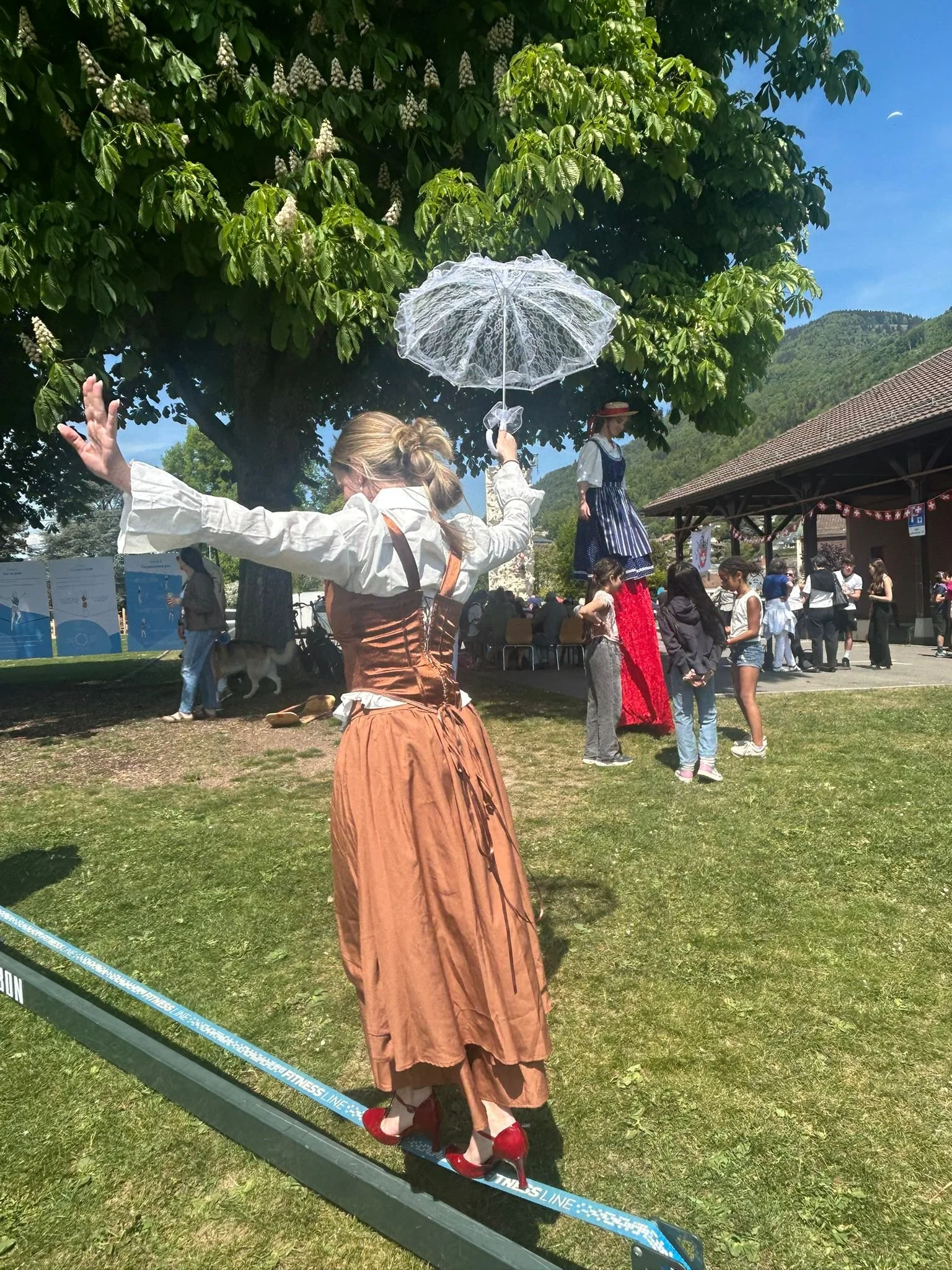
Slackline activity for the 150th anniversary of the Swiss Alpine Club, Jaman section, in Blonay
On Saturday, May 2, 2026, the Jaman section of the Swiss Alpine Club celebrated its 150th anniversary at the Chalet du Grillet, located at an elevation of 1,185 meters along the Blonay–Les Pléiades trail. Slackline Events set up a slackline activity for the Swiss Alpine Club capable of accommodating nearly 200 participants over six hours, supervised by a single operator. Here is a recap of this anniversary celebration at high altitude.
Background: 150th Anniversary of the CAS Jaman Section
Founded on October 14, 1876, the Jaman Section is one of the oldest sections of the Swiss Alpine Club, whose parent organization was established in 1863. Based in Vevey, it manages a remarkable collection of mountain huts—from the Chalet du Grillet, above Blonay–Saint-Légier, to the Bertol Hut and the Col de la Dent-Blanche bivouac, including the Mont-Fort Hut.
To mark its 150th anniversary, the committee chose a format that reflects its spirit: no formal gala in the valley, but a day at the Chalet du Grillet, at an elevation of 1,185 meters, accessible on foot from Ondallaz. An alpine setting, an audience of families and club members, and a highlight event that is particularly significant given the sport’s history.
Why a slackline for an alpine club anniversary?
Few people know this, but modern slacklining originated among rock climbers. In the early 1980s, in California’s Yosemite Valley, climbers like Adam Grosowsky and Jeff Ellington stretched the first flat webbing straps between two trees to train on rainy days. Forty years later, the sport has spread across the globe, but its roots remain the same: balance, managing risk, reading the terrain, and trust in the equipment. These concepts immediately resonate with a climbing community.
- For the 150th anniversary of the Jaman section, bringing together the history of the CAS and that of slacklining wasn’t just a marketing gimmick. It made perfect sense. As one committee member remarked during the event, “Your straps are kind of like our ropes, but more flexible.”
The challenge: 200 participants, one instructor, six hours, at high altitude
The Chalet du Grillet is not your typical event venue. There’s no nearby parking, no unlimited running water, and no room for large-scale logistics. The party took place on the chalet’s terrace and the grassy area outside. For the slackline activity, this meant:
- This gear was carried on foot from Ondallaz, so it was designed to be lightweight and compact.
- There weren't any trees of the ideal size along every route—we had to assess the terrain upon arrival and choose the best pair of anchor points.
- A single ground crew member to manage the entire day.
- A diverse group: children of club members, young trainees, and veteran mountaineers. Three groups, three paces, three approaches to balance.
The real problem with this kind of event is never the setup. It's everything that comes after.
Our solution: five minutes to assemble, six hours to deliver
The equipment is designed to be set up quickly. Anchors, straps, protective covers—everything is designed to be installed in just a few minutes, without heavy tools or permanent anchors in the ground. On this point, customers always ask the same question— “How do you set this up so fast?” —and the answer often disappoints them: speed isn’t our specialty. It’s just a prerequisite.
That’s when the real work begins. Specifically, on Grillet Day:
- A visual briefing using cards is distributed to participants while they wait, so that when they get on the line, they already know where to place their feet and where to look.
- A rotation lasting two to three minutes per person is sufficient to get a feel for the activity and make progress, provided that the instructions are clear and the debriefing is brief.
- A passive safety feature: a low strap, a cushioned surface underneath, and operator intervention only when necessary—not constant support that tires everyone out.
- Real-time monitoring: prioritize children when parents are waiting, quickly identify who wants to try out the equipment and who just wants to watch, and adjust the duration of each session based on the line.
Five minutes to set up. Six hours to run. It’s that second part that makes the difference between an event that fizzles out before noon and one that keeps the crowd engaged until the very end.
Highlights
The expected snowball effect kicked in right from the start: the first participants drew in spectators, the spectators became participants, and the slackline was in constant use until the end of the day.
But the most memorable moment was generational: seeing a longtime member of the group [[to be completed: approximate age, if known]] step onto the strap, cheered on by the younger members, in a cabin he has been visiting for decades. That is what a well-organized event achieves—a common ground between groups of people who don’t usually come together for the same activity.
The same phenomenon can be observed at other high-altitude events we’ve covered, including an introductory workshop in Les Ménuires held as an open après-ski event and an aerial show for Alpine ski resorts.
The results
On May 2, 2026:
- Approximately 200 participants tried slacklining (internal estimate by Slackline Events).
- Zero security incidents.
- A single operator was sufficient to oversee the entire operation.
- The event ran continuously for six hours, without any forced breaks or a loss of audience interest.
Why slacklining works for an alpine club event
If you’re on the committee of another CAS section or an alpine or outdoor association, here are the specific reasons why this format works so well:
- The terminology is familiar. Balance, commitment, passive safety, belaying: your audience doesn’t need to learn anything new—they simply apply what they already know about rock climbing and ropes.
- You can spot it from a distance. Whether on a terrace, a grassy spot, or an alpine meadow, the strap catches the eye without getting in the way of the rest of your day.
- It’s an open format. No set times, no advance registration. People drop by, give it a try, leave, and come back. That’s the rhythm of a day at a high-altitude community center.
- Staffing levels have been determined. For 200 participants over a six-hour period, one professional operator is sufficient. For larger groups, a second operator or a second line becomes necessary.
- The equipment is portable. An event can be set up at a remote cabin, provided that the service provider is accustomed to carrying their equipment on foot.
In summary
A slackline activity for an alpine club anniversary takes five minutes to set up and requires six hours of active supervision. The value isn’t in the setup: it lies in the ability to engage a large audience for an entire day, in a sometimes challenging alpine setting, using simple equipment and a team of instructors. To discuss a similar format for your chapter or organization, explore our introductory slackline workshops, our highline shows for mountain events, or our full collection of case studies.
3. SEO FAQ
What's the connection between slacklining and mountaineering?
Modern slacklining originated among Yosemite climbers in the early 1980s as a way to practice balance on rainy days. It shares a common vocabulary with mountaineering: balance, commitment, reading the terrain, and trust in the equipment. This is what makes it a great activity for an alpine club or outdoor association event.
Is a slackline activity suitable for a CAS section birthday party?
Yes. The open format, professional guidance, and visual aspect make it suitable for a diverse group of club members—children, young people in training, and veterans. The terminology is familiar to climbers, and the activity is accessible to all ages. See our introductory slackline workshops for details.
How long does it take to set up a slackline at an event?
Setup takes five to ten minutes on a site with two suitable anchor points (trees, structures, weighted blocks). The equipment is designed for quick deployment without heavy machinery. However, setup time is only a fraction of the work involved: the quality of the experience depends on the supervision and interpretation of the content.
How many people can participate in a one-day slackline event?
With a single instructor, a beginner slackline session can accommodate between 150 and 250 participants over six hours, in an open-format session with a quick briefing. Beyond that, a second instructor or a second line is required to ensure the quality of the experience.
Can you set up a slackline at high altitudes or in a mountain chalet?
Yes, provided that two anchor points are available (sturdy trees, structures, or weighted blocks brought to the site) and that the ground is sufficiently level over a distance of 15 to 20 meters. The equipment can be carried on foot from the parking lot or the nearest rest stop, making it possible to set up at locations such as an alpine chalet or a mountain hut that is inaccessible by vehicle.
Do you need a specific type of terrain to set up a slackline?
Almost any flat, open area will do. You’ll need two anchor points spaced 8 to 15 meters apart: sturdy trees, poles, fixed structures, or weighted blocks that we provide. Grass, sand, alpine meadows, or snow all work, as long as you leave a fall zone of about two meters on each side of the strap.
At what age can you start slacklining?
Children as young as four can participate with adult supervision, and independently starting at six or seven years old. Seniors can also participate without difficulty as long as they have normal balance and mobility. The beginner slackline is set very low and is manageable for all typical members of a mountaineering club.
How many supervisors are needed for 200 participants?
A single experienced operator is sufficient for 200 participants over a six-hour period, provided the setup is designed to handle the flow: visual briefing, low harnesses, passive safety measures, and short rotation times. For very young or more dependent participants, a second supervisor is recommended.
How much does a slackline activity cost for a club anniversary?
The price depends on the duration, the number of lines installed, the distance to the site, and the package selected (introductory session only, introductory session + show, workshop + acrobatic show). For a six-hour session with one line and one operator, the all-inclusive price covers equipment, transportation, supervision, and insurance. Request a quote via our introductory workshops page.
Do you need special insurance to organize a slackline workshop?
The organizer retains its standard liability insurance, and the service provider must provide its own professional liability insurance covering slacklining activities. Slackline Events proof of coverage upon request before the contract is signed. For an alpine club chapter, this is a simple but essential verification step.
What happens if it rains or if there are bad weather conditions at high altitudes?
A beginner slackline activity can still take place in light rain, provided the slackline remains dry. In the event of heavy rain, strong winds, or slushy conditions, the activity will be suspended for safety reasons. For events at high altitudes, a backup plan in a sheltered location or an alternative time slot will be discussed in advance.
Can slacklining be combined with a performance for an alpine club event?
Yes. A birthday celebration can combine a continuous introductory workshop with a highline performance at height or an acrobatic show on the ground at specific times (opening, cocktail hour, closing). For an audience of mountaineers, the highline show has special significance, as it directly extends the experience of being at height.