

Slacklining at the Diabolo Festival in Morges: workshops and a show for kids
When you arrive at the Diabolo Festival in Morges, the energy is palpable right away. Theater, magic, circus, shows, workshops—every corner of the Beausobre site is designed to offer an experience for children ages 2–10. It was in this setting that we participated in 2025 with a slackline activity for the children’s festival: two days of introductory workshops and an acrobatic slackline show to make the activity accessible to the youngest participants.
The festival welcomed nearly 9,400 attendees that year, and we saw many of them at the slackline area.
Why slacklining works so well with kids
Children have an instinctive sense of balance. They climb everywhere, jump on everything, and are constantly looking for ways to test their limits. Slacklining channels this energy into a supervised, fun, and progressive activity.
Our introductory slackline workshops are successful because they combine three elements: a real physical challenge—which makes success rewarding—learning through trial and error—which keeps participants engaged—and a flexible strap that bounces under your feet—which makes it fun, even when you fall.
For children under 7 or 8, the challenge is different: at this age, motor coordination is still developing, and standing on a strap is still too difficult. That is why a special device is used.
A balance course for young children (ages 2–7)
The Diabolo Festival is open to children as young as 2. At that age, traditional slacklining isn't an option—they need something else.
So we set up an additional balance course featuring a trampoline, stepping stones, and obstacle modules. The idea is simple: to offer challenges tailored to each child’s motor skills, without causing frustration. The course is open for free use all day long. The children come back to it several times, make progress as they move through the modules, and often end up trying a beginner slackline with a supervisor.
It’s a gentler version of what we put on in our more ambitious productions—for example, at the Verbier Air Show for Family Day —adapted here for a very young audience.
Slacklines suitable for children, teens, and parents
The activities are organized by age group:
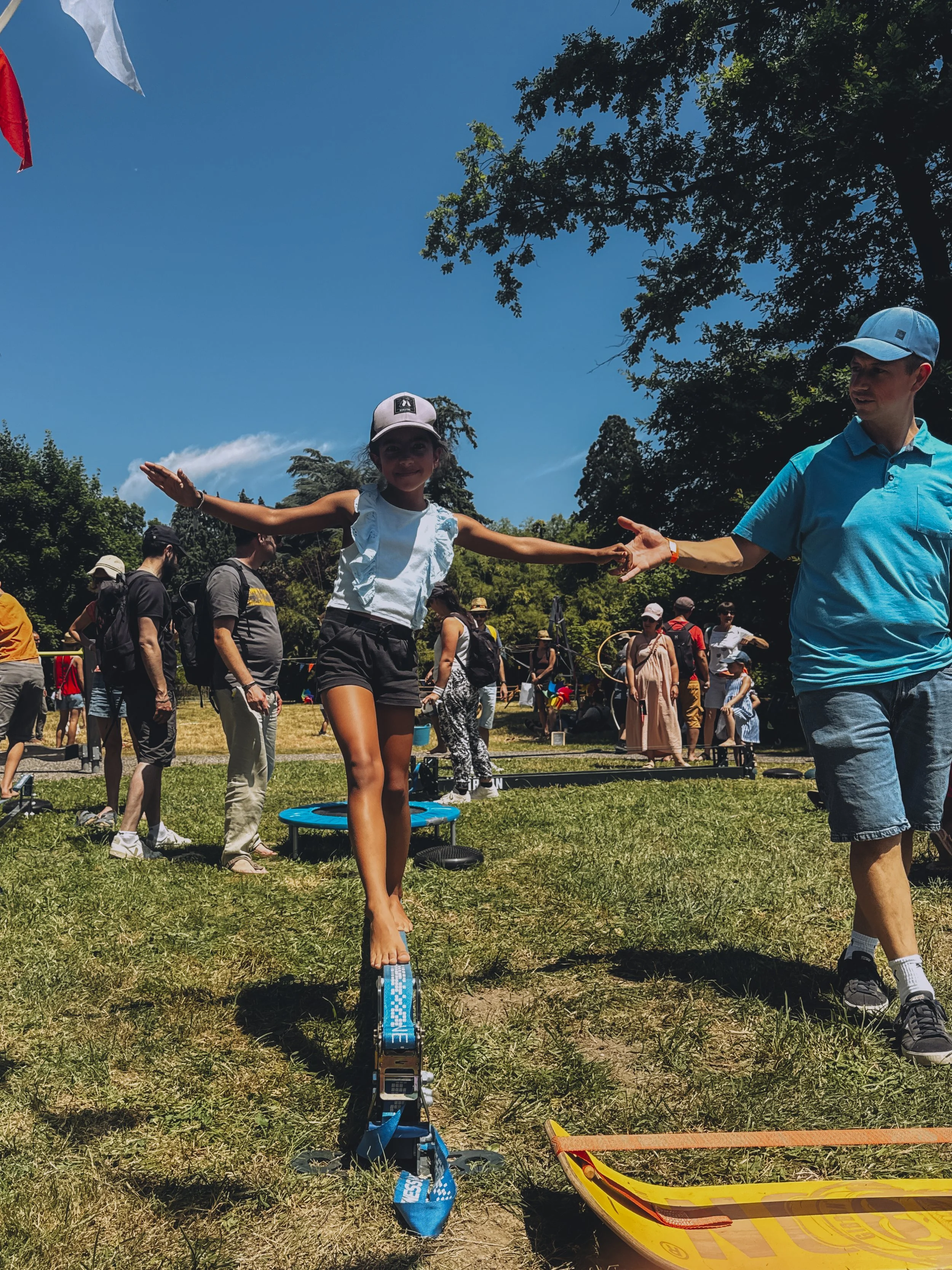
- Beginner slacklines (very low, short, wide) for children ages 7–8 and up
- Intermediate slacklines for teens looking for a real challenge
- Longer slacklines for adults — because at family festivals, parents come along, wait around, and often want to give it a try themselves
Each line is supervised by an instructor. It is the instructor who ensures safety during the first attempts, adjusts the difficulty level, and provides the right guidance to help participants stay on the line for a few seconds—which, at this age, is enough to bring out genuine joy.
The winning combination: workshop + acrobatic slackline show
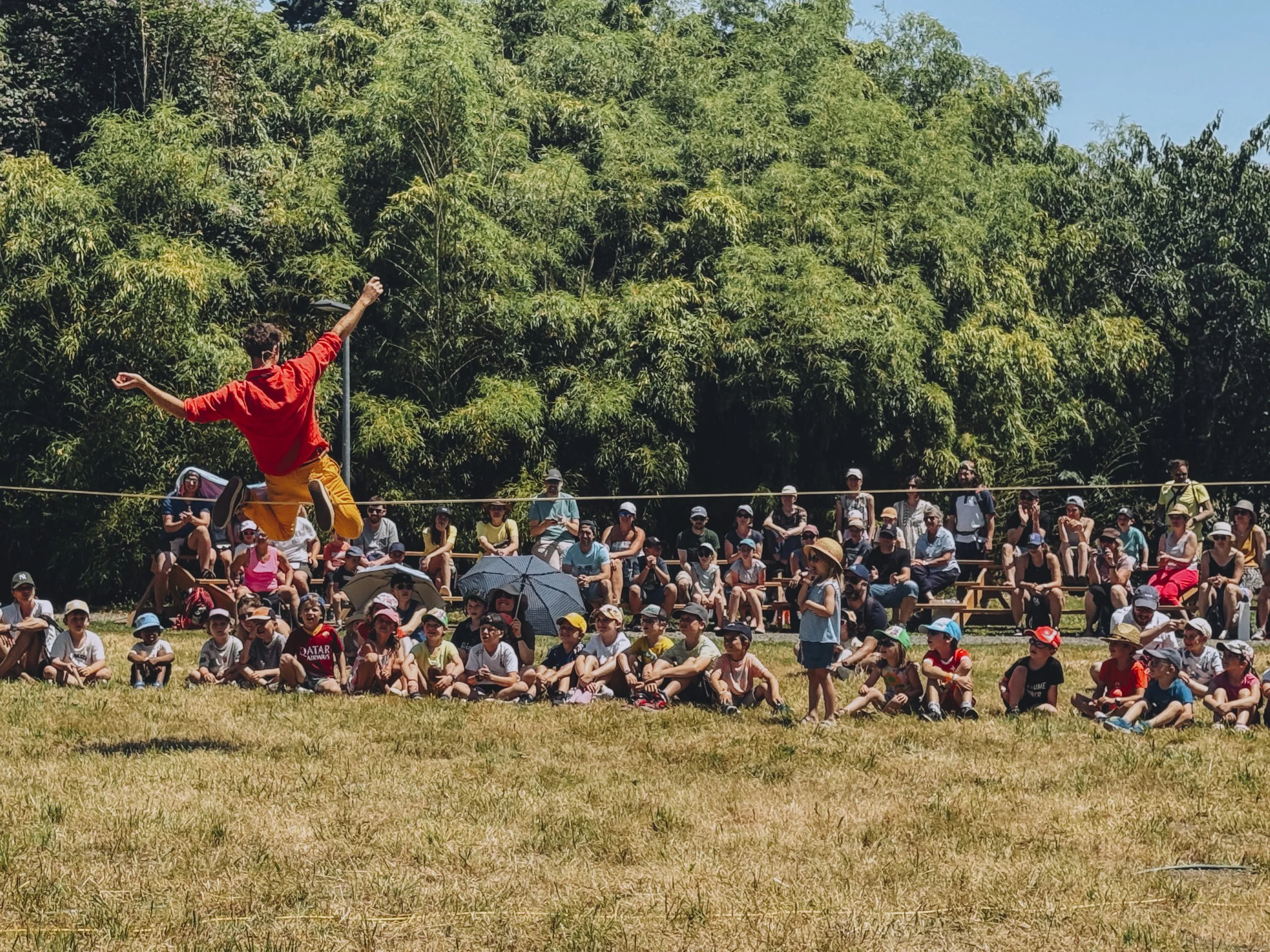
The best format for a festival aimed at young audiences is an introductory workshop paired with a performance. During the day, the children get a taste of the discipline. When the show begins, they see what that same discipline can achieve in the hands of a professional athlete.
Our acrobatic slackline show features a series of flips, twists, and tricks several meters above the ground. When a performer lands a double backflip in mid-air, the kids scream. Literally. It’s a moment of intense excitement that you rarely find in other performances.
And that changes everything going forward. After the show, the kids immediately want to head back to the workshops. They no longer see the slackline as just a balancing game—they see it as a world where they can improve. And they want to be a part of it.
For festivals that prefer large-scale aerial performances, our highline show features a longer and higher line, creating an even more striking visual effect. This is the format we used at the Forum Fribourg for its grand opening.
Gamified learning: our card game for kids
To make the workshop even more engaging, we designed an educational card game. Each card presents a challenge to complete on the slackline: take three steps, walk backward, turn around on the line, balance on one foot, or perform two basic tricks in a row.
The children draw a card, attempt the challenge, confirm their success, or try again. This gamification has a clear effect: they spend more time in the workshop, make faster progress, and leave with a real sense of accomplishment.
This also explains a detail that really strikes a chord with us. At children’s festivals, QR codes are placed for people to leave Google reviews—except that kids don’t have Google accounts. So they grab the flyers, run to their parents, and insist that they scan them. Feedback from organizers is along the same lines: this isn’t just entertainment you consume; it’s an experience that leaves a lasting impression.
Results and Impact of the 2025 Diabolo Festival
The 2025 edition was a success for the organizers of the Diabolo Festival, with an attendance rate of nearly 97% over the two days despite the heat. On the slackline side, our workshops ran continuously, the balance course was constantly busy, and the acrobatic show served as a catalyst: attendance at the workshops peaked immediately after each performance. The Google reviews shared by parents are the most tangible proof of this.
Tips for organizers of children's festivals
Here are a few key takeaways from our experience with this type of event:
- Choose a large, flat area for the workshop, ideally one that is shaded in the afternoon. Allow at least 6×15 meters for two slacklines and a balance course.
- Think flow and rotation: at a festival, kids want to try out several activities. A 5- to 10-minute session per child is ideal—long enough to get the hang of it, but not long enough to back up the line.
- Combine a workshop with a show when the budget allows. That’s the emotional spark that makes the experience truly special.
- Mention the minimum age requirement in the official program. Specifying that there is a tailored program for children ages 2–7 helps prevent frustration among parents.
- Lay the groundwork in advance: We handle the setup and supervision, but the organizer must approve the anchoring points (trees, load-bearing structures, or suitable posts).
Shall we talk about it?
If you’re organizing a children’s festival, a family celebration, or a cultural event and are looking for a unique activity, contact us through our booking page or by email at info@slackline-events.com. We’ll work with you to determine the right package (workshop only, workshop + show, half-day, or full-day) and send you a customized proposal. To see other formats used in a wide variety of settings, our case studies provide a good overview.
SEO FAQ
At what age can a child start slacklining?
Starting at age 7 or 8, children can try supervised slacklining on a beginner-friendly line (low, short, wide). For younger children, we offer an adapted balance course (trampoline, stepping stones, modules) that helps develop motor skills without causing frustration. At the Diabolo Festival, which welcomes children ages 2–10, we run both programs simultaneously.
How long does a slackline workshop for kids last?
At a festival, we rotate the children in 5- to 10-minute sessions per line. That’s enough time to get the hang of it, get a feel for the harness, and take their first steps—but not enough to overwhelm the line. For school or birthday parties, our introductory workshops last 1 to 2 hours, depending on the group.
How much space is needed to set up a slackline activity at a festival?
Allow at least 6 × 15 meters for two slacklines and a small balance course. For a more complete setup (3 slacklines + course + performance area), allow 10 × 25 meters. The ground must be flat, clear, and suitable for anchoring to trees, support structures, or dedicated stakes.
Is slacklining dangerous for children?
No, on beginner slacklines set up 30–50 cm above the ground and supervised by an instructor, the risk is very low—comparable to that of riding a scooter or navigating an obstacle course. Falls are common but minor: you land on your feet or grab the instructor’s hand. All of our equipment complies with current safety standards.
Is any special equipment or safety gear required?
For the workshops and balance course designed for children, no special equipment is required—just comfortable sneakers. For the highline performance at height, the performers are equipped with safety harnesses and protective gear, and the line is secured with a dual backup system.
How many children can participate at the same time?
With two instructors, two slacklines, and a balance course, we can accommodate between 60 and 120 children per hour, depending on the festival’s foot traffic. Over the two days of the Diabolo Festival, we therefore see several hundred participants per weekend.
What happens if it rains or the weather is bad?
Slacklining is still possible in light rain, but you should avoid heavy downpours (the line becomes slippery) and thunderstorms. Most festivals for young audiences have backup plans involving tents or indoor venues—we adapt our setup accordingly.
How much does a slackline activity cost for a children's festival?
Prices depend on the duration (half-day, full day, weekend), the number of instructors, and whether or not a show is included. As a general guide, a full day of workshops with two instructors and a balance course starts at around CHF 2,500. For a detailed quote tailored to your event, please contact us via the booking form.
Can we combine the workshop with a slackline show?
Yes, that’s actually the format we recommend for children’s festivals. The show (15–20 minutes) acts as an emotional catalyst: after watching a performer pull off a series of tricks, the kids flock back to the workshops. The workshop-plus-show combo is our most popular package at festivals.
Do you need trees to set up a slackline?
Not necessarily. We install the structure on trees if the festival site has suitable trees (with trunks at least 30 cm in diameter and in good health); otherwise, we set up our own freestanding anchor points. The decision is made during a preliminary site inspection.
What is the difference between a slackline, a highline, and a trickline?
A slackline is a strap stretched at a low height (30 cm to 1 m), ideal for beginners. A trickline is tighter and more springy: this is the one used for acrobatic performances (flips, spins, tricks). A highline is a slackline set up several meters or even tens of meters high, for spectacular aerial performances. Our services pages provide details on each type.
What kinds of events for young audiences do you host?
We regularly perform at children’s festivals (such as the Diabolo Festival in Morges), community family celebrations, school fairs, birthday parties, museum open houses, and family-friendly corporate events. Our portfolio of case studies provides an overview of the variety of formats we offer.


Double-click to edit...
Double-click to edit...
-
Description text goes here
-
Description text goes here
-
Description text goes here
Double-click to edit...